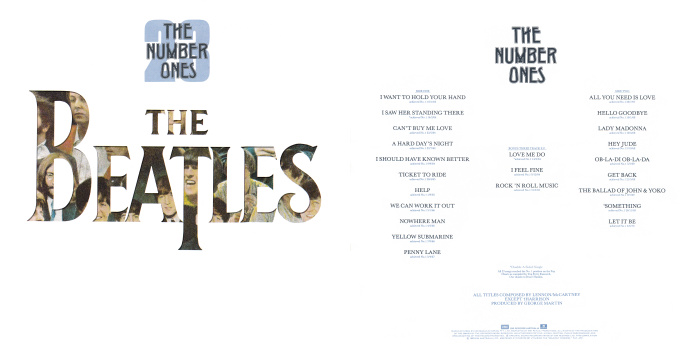
THE NUMBER ONES
Parlophone PLAY 1024
Released 13 May 1983
Original recommended retail price: $10.99
Released in Australia on 13 May 1983, The Number Ones was a locally compiled collection of The Beatles’ Australian chart-toppers, uniquely supplemented by a three-track “bonus” EP and becoming a No. 1 hit after heavy television and in-store promotion.
Labels & Related Material
Tracks

Side 1

Side 2

1. I Want To Hold Your Hand

1. All You Need Is Love

2. I Saw Her Standing There

2. Hello, Goodbye

3. Can't Buy Me Love

3. Lady Madonna

4. A Hard Day's Night

4. Hey Jude

5. I Should Have Known Better

5. Ob-La-Di, Ob-La-Da

6. Ticket To Ride

6. Get Back

7. Help!

7. The Ballad of John and Yoko

8. We Can Work It Out

8. Something

9. Nowhere Man

9. Let It Be

10. Yellow Submarine


11. Penny Lane


Side 1

Side 2

1. Love Me Do

1. I Feel Fine


2. Rock and Roll Music

Pressing & Mastering

First Issued

Side 1

Side 2

Parts

13-May-83

✎PLAY 1024 A OR

✎PLAY 1024 B OR

AU

Sleeve Information

Code

Circulated

Comments

AU1

May-83

Copies came sealed in extremely tight shrink wrap that damaged the sleeve over time

Overview
When Britain and the United States issued their own versions of 20 Greatest Hits in October 1982, an Australian edition needed more than a change of running order. The Beatles’ local chart history supplied twenty-three No. 1 selections—and potentially more if every double A-side was counted. EMI (Australia) therefore adopted the more appropriate title The Number Ones for its May 1983 release.

Fitting the selection onto vinyl required a compromise. Even with three tracks removed, side two ran for more than thirty-two minutes and was cut at a low level. 'Love Me Do', 'I Feel Fine' and 'Rock and Roll Music' were supplied on a separate disc promoted as a “bonus EP”. Technically, however, it belonged to EMI’s singles catalogue, with a singles-series catalogue number and matrix numbers. Nor were the three recordings really extras: they formed part of the collection’s core selection.

Compiler Bruce Hamlin chose both the tracks and their sources. His deliberate inclusion of the October 1963 stereo mix of 'I Want to Hold Your Hand' gave the album its most distinctive feature: it was the only album worldwide to contain that mix. The source was a 1982 dub of the Australian single, however, and an audible speed fluctuation affects the first second.

Bruce also wanted Capitol’s repaired version of 'I Should Have Known Better', as heard on the American Reel Music, without the harmonica interruption in the introduction. Although EMI (Australia) possessed the relevant Capitol tape, the standard British stereo mix was used instead. An earlier proposal for a gatefold sleeve and a twelve-inch single containing 'Hey Jude' also fell away because of budget restrictions.

The release created an unusual opportunity for Australian buyers: the 1963, 1965 and 1966 stereo mixes of 'I Want to Hold Your Hand' could all be bought concurrently, depending on the album selected.

Otto Ruiter mastered The Number Ones at Studios 301 using Maxicut. Extensive television and in-store promotion helped it reach No. 1 during a nineteen-week chart run. World Record Club members could obtain it on release for $8.99, two dollars below the $10.99 recommended retail price.

The cassette outlasted local vinyl manufacture. In 1991, after EMI (Australia) ceased pressing records, it entered EMI’s global “7 series” as 0 777[7 96432 4] 0—arguably giving this Australian compilation a place in the wider core catalogue. It continued to use the existing analogue production masters and was therefore not an XDR edition like the digitally remastered cassettes.

The cassette sequence
Without the LP’s space restrictions, the cassette restored the three separately supplied tracks to their chronological Australian release positions. Side one ran: 'I Want to Hold Your Hand'; 'Love Me Do'; 'I Saw Her Standing There'; 'Can’t Buy Me Love'; 'A Hard Day’s Night'; 'I Should Have Known Better'; 'I Feel Fine'; 'Rock and Roll Music'; 'Ticket to Ride'; 'Help!'; 'We Can Work It Out'; 'Nowhere Man'; 'Yellow Submarine'; and 'Penny Lane'. Side two ran: 'All You Need Is Love'; 'Hello, Goodbye'; 'Lady Madonna'; 'Hey Jude'; 'Ob-La-Di, Ob-La-Da'; 'Get Back'; 'The Ballad of John and Yoko'; 'Something'; and 'Let It Be'. Curiously, side two still played at a lower level, even though cassette side one ran more than three minutes longer.

How 'I Want to Hold Your Hand' reached the album
The story began with EMI’s campaign to reissue the official Beatles singles after its contract with the group expired in early 1976. In Australia, only 'Rock and Roll Music'/'Honey Don’t' remained available from the first eighteen singles. Seventeen therefore needed to be restored alongside the twelve later singles still in print.

New sources were obtained for six pairings: 'From Me to You'/'Thank You Girl'; 'She Loves You'/'I’ll Get You'; 'I Want to Hold Your Hand'/'This Boy'; 'Love Me Do'/'I Saw Her Standing There'; 'I Feel Fine'/'She’s a Woman'; and 'Ticket to Ride'/'Yes It Is'. Their earlier masters and metal parts had been disposed of during their years out of print, making new cuts necessary.

Documentation shows that some replacement recordings came from locally held tapes, using stereo where available. Others, including at least 'I Want to Hold Your Hand' and 'This Boy', were newly supplied by EMI UK. Alongside the standard stereo 'This Boy', Britain unexpectedly sent the October 1963 stereo mix of 'I Want to Hold Your Hand', rather than the November 1966 mix prepared for A Collection of Beatles Oldies. EMI (Australia) used the supplied recording.

After the singles appeared, Capitol requested a copy of that tape. EMI (Australia) sent the actual tape without retaining a duplicate; Capitol appears never to have used it.

In 1982, a damaged mother required 'This Boy' to be recut. The engineer initially selected the recording on the Love Songs master, PARLO 469. Immediately before plating, Bruce pointed out that this was fake stereo and recommended using the 1976 single to recover the original stereo version, since its tape had gone to Capitol.

An employee dubbed both sides of the single onto a 30 ips tape. 'I Want to Hold Your Hand' was copied only for preservation, rather than for the immediate recut, and insufficient care was taken at the start. Either the turntable had not reached speed or the stylus was cued too close to the opening, introducing the audible “wow”. When compiling The Number Ones the following year, Bruce selected this dub, preserving both the rare stereo mix and the flaw in its first second.