Promotional Records and the Australian Radio Industry

How record-company representatives, radio programmers and promotional departments helped determine what Australia heard

Promotional records formed part of a much broader system used by EMI (Australia) and other record companies to place new releases before radio stations, announcers and the music press. While some Beatles and solo releases were manufactured with distinctive promotional labels, overprints, stickers or sleeves, others appear to have been distributed as ordinary stock copies with no identifying promotional markings. Examining how records and related material were supplied to broadcasters therefore provides important context for understanding both the promotional issues that survive today and the apparent absence of dedicated promo versions for many Australian releases.

Based on recollections provided by Jeffrey Black, Community/Commercial Announcer (Ret’d), with additional input from Craig Braun, former NSW State Manager, EMI (Australia).

What was a promotional record?
Promotional records — commonly known as “promo” records — were supplied by record companies to radio stations, broadcasters, reviewers and other members of the media for promotional or review purposes.

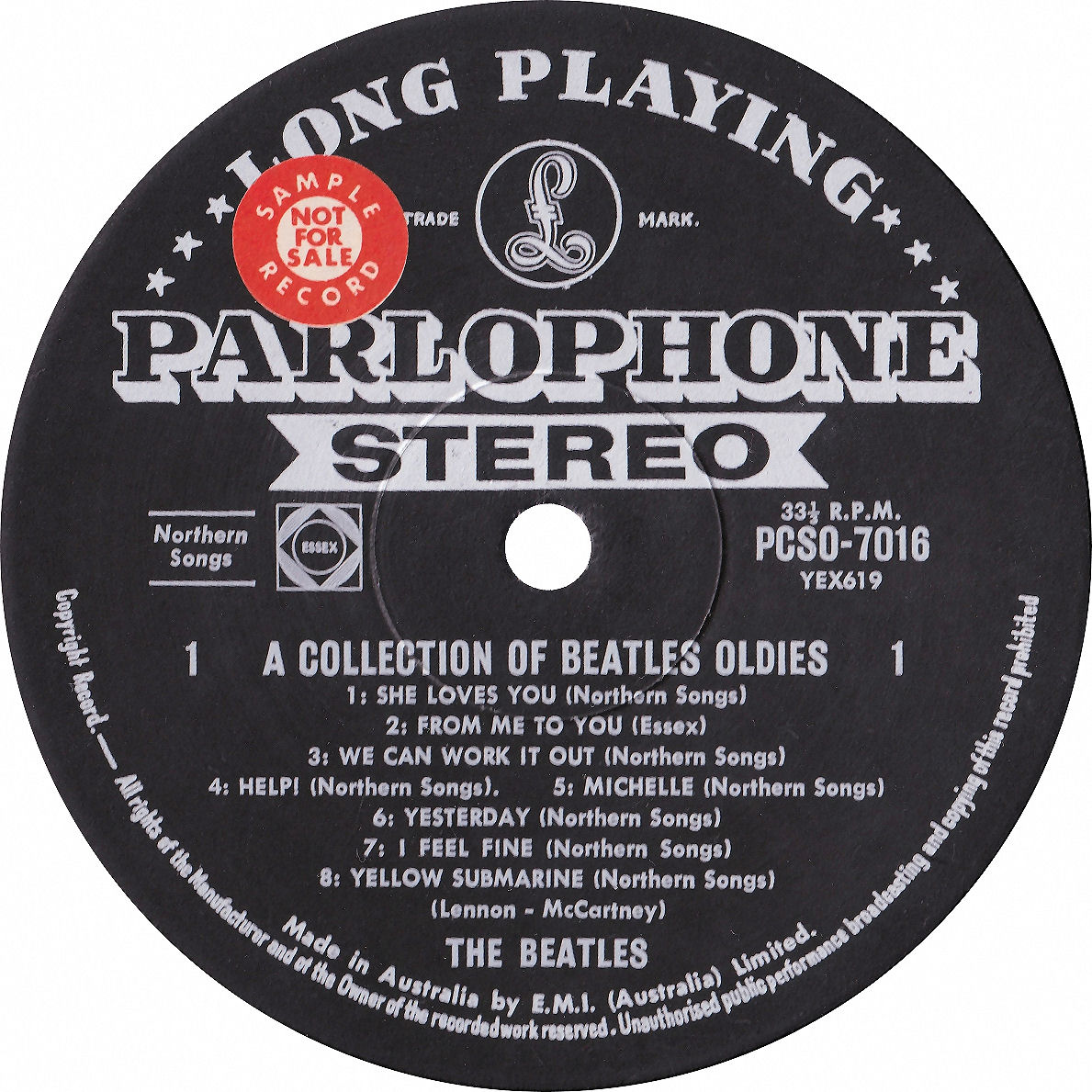
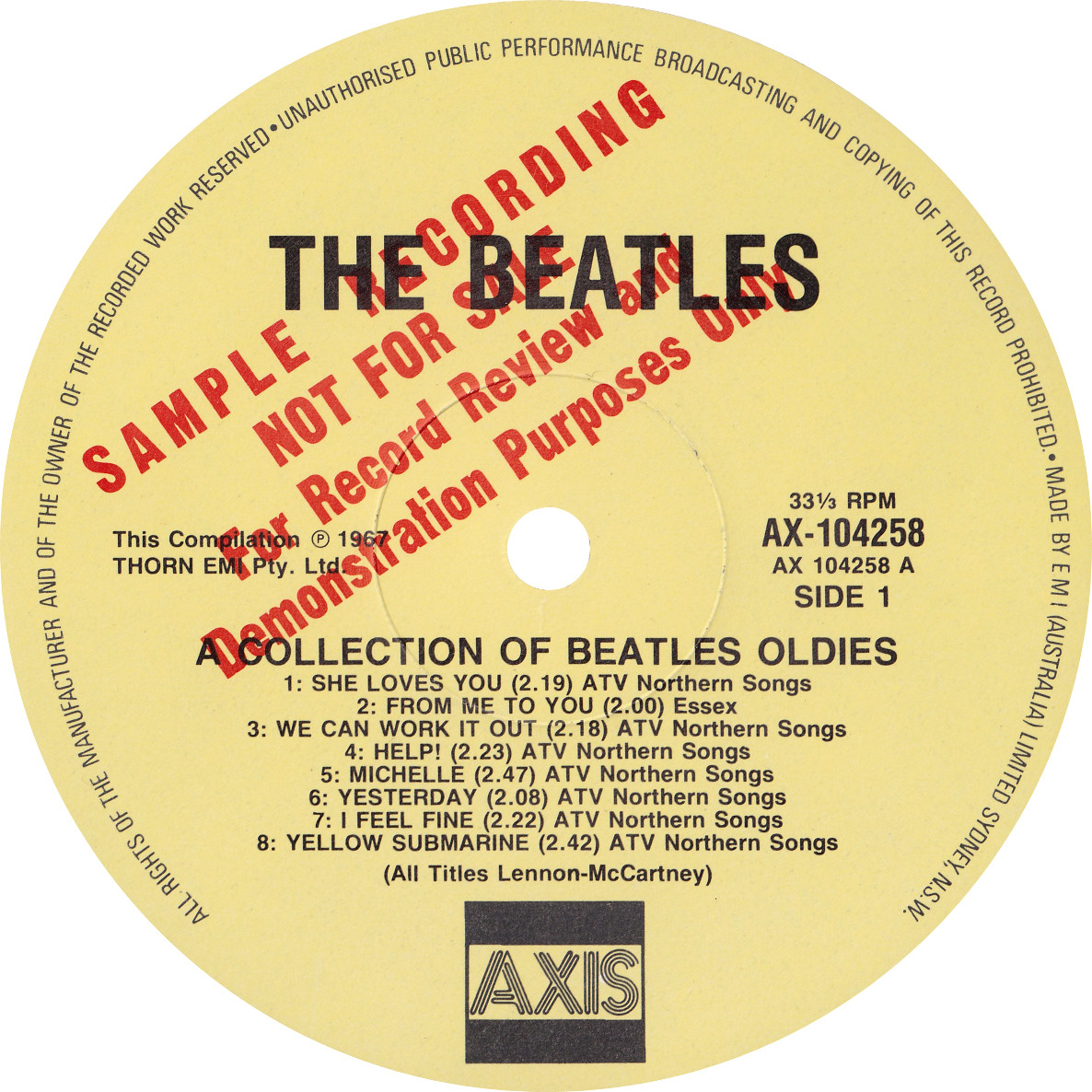
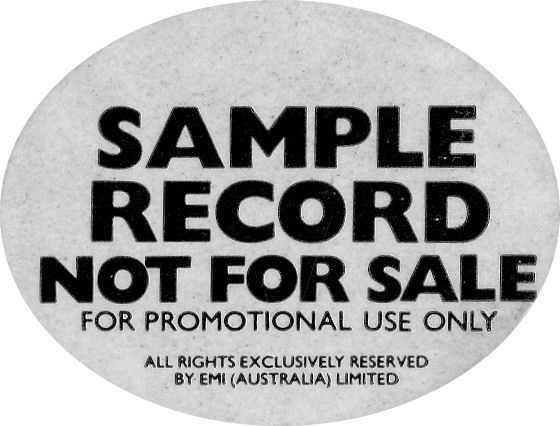
They were generally distributed free of charge and were not intended for retail sale. Dedicated promotional copies were usually identified by a distinctive label, overprint, stamp or sticker applied by the manufacturer. Many carried wording such as “SAMPLE RECORD — NOT FOR SALE” or “FOR PROMOTIONAL USE ONLY”.

Although they were never intended to enter normal retail channels, many inevitably did. Former radio-station copies, reviewer copies and other promotional records subsequently found their way into second-hand record shops and private collections, where distinctive promotional variants have become highly collectable.

During the 1960s and early 1970s, promotional singles appear to have been considerably more common than promotional LPs. Commercial radio was largely singles-driven, and most albums were represented by one or more concurrent singles that could be promoted directly to broadcasters. There was therefore less need to distribute large numbers of full albums.

Australian Beatles promotional records are nevertheless known across all three principal vinyl formats: singles, EPs and LPs.

How promotional records reached Australian radio
At EMI (Australia), new 7-inch releases were routinely sent to radio stations as part of the company’s regular promotional servicing. This ensured that stations received current singles automatically, without needing to request each title individually. For many releases, EMI (Australia) typically pressed around 300 copies for promotional purposes, providing stock for radio servicing, media promotion and related promotional activity.

In practice, EMI’s system combined routine servicing with targeted promotion. Regular distribution placed new releases before station programmers and announcers, while particular records selected for an additional push could receive much more direct attention from EMI (Australia) staff. Receipt of a record did not, however, mean that it automatically became part of the station’s permanent library. Stations assessed incoming material against their format and programming requirements, and records that were not used could subsequently be given away or simply discarded.

The exact form that promotion took depended partly on the size and importance of the market. In the major metropolitan centres, dedicated promotion staff were able to work directly with radio stations. In smaller markets, sales representatives could perform much the same function alongside their normal commercial responsibilities.

The record company representative
The record company representative was the personal link between the label and the broadcaster.

At EMI (Australia), routine servicing ensured that new 7-inch releases reached radio stations, but representatives played a more active role in promoting selected records. In the larger metropolitan markets, dedicated promotion staff maintained relationships with Music Directors, Program Directors and influential announcers, visiting stations to draw attention to priority releases, leave additional copies and organise promotional activity.

A representative might arrive with several copies of one particularly important single, hand them directly to key announcers, leave copies with the Music Director or provide supporting publicity material. In some cases, they also worked with station staff to arrange on-air promotions, competitions, interviews or other activity designed to generate interest in a particular artist or release.

At stations where announcers retained some freedom over their own selections, prominent “personality jocks” could also receive records directly.

In smaller markets, including centres such as Canberra and Newcastle and in regional areas, the role was often less specialised. Sales representatives could effectively wear two hats, combining their normal retail sales responsibilities with radio promotion. Their rounds could therefore include both record shops and local broadcasters, allowing them to promote priority releases while servicing commercial accounts.

The system was therefore both organised and personal: routine distribution ensured that new releases reached broadcasters, while representatives provided the additional push that could help turn a new record into one that received serious airplay.

Inside the radio station library
Not every promotional record supplied to a radio station ultimately entered its permanent record library.

The working library was generally built around records that the station actually played, together with titles that charted or otherwise remained relevant to its programming. Records that attracted little interest, failed to suit the station’s format or were simply never used could be removed from consideration fairly quickly. Some were subsequently used as station giveaways, while many were simply discarded.

Large metropolitan stations could retain considerably more material. Jeffrey Black recalls major stations such as 4BC in Brisbane and 2UW in Sydney maintaining subsidiary collections containing records that had received some airplay or achieved only relatively low chart positions, rather than keeping everything within the main working library.

Once a record was accepted for use, it could be catalogued using the station’s own numbering system and annotated with information needed by announcers.

This might include the precise running time, whether the recording began immediately or with an instrumental introduction, the nature of the ending — whether it stopped cleanly or faded — and sometimes a description of the musical style or mood.

Australian recordings could also carry station annotations identifying their local content. The codes CPA and CPO were used on Australian tracks, although terminology and practices could vary between stations and over time. Surviving station sleeves and library copies sometimes retain these handwritten or stamped markings, providing another glimpse of how records were classified internally.

The important distinction is that record-company servicing and station-library retention were two different processes. A station might receive a record without ever playing it, and in some cases dispose of it without it ever entering regular rotation. Some stations also maintained supplementary libraries in which records carried clear instructions from the Music or Program Director that they were not to be played.

As a result, a large proportion of the promotional material — including records — originally distributed to Australian radio has consequently disappeared. This loss was particularly significant during successive technological transitions, first from vinyl to CD and later from physical media to streaming, networked radio systems and local digital music servers.

How radio stations prepared records for airplay
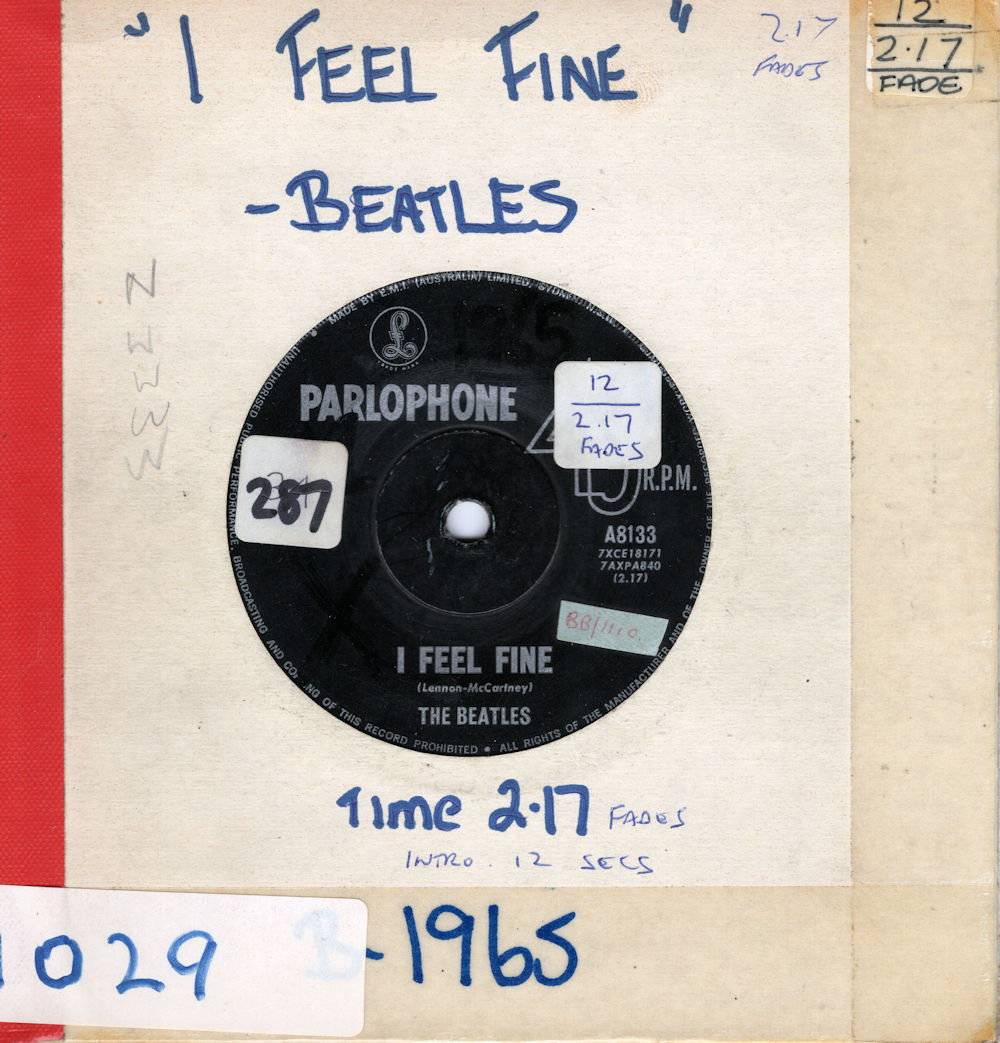
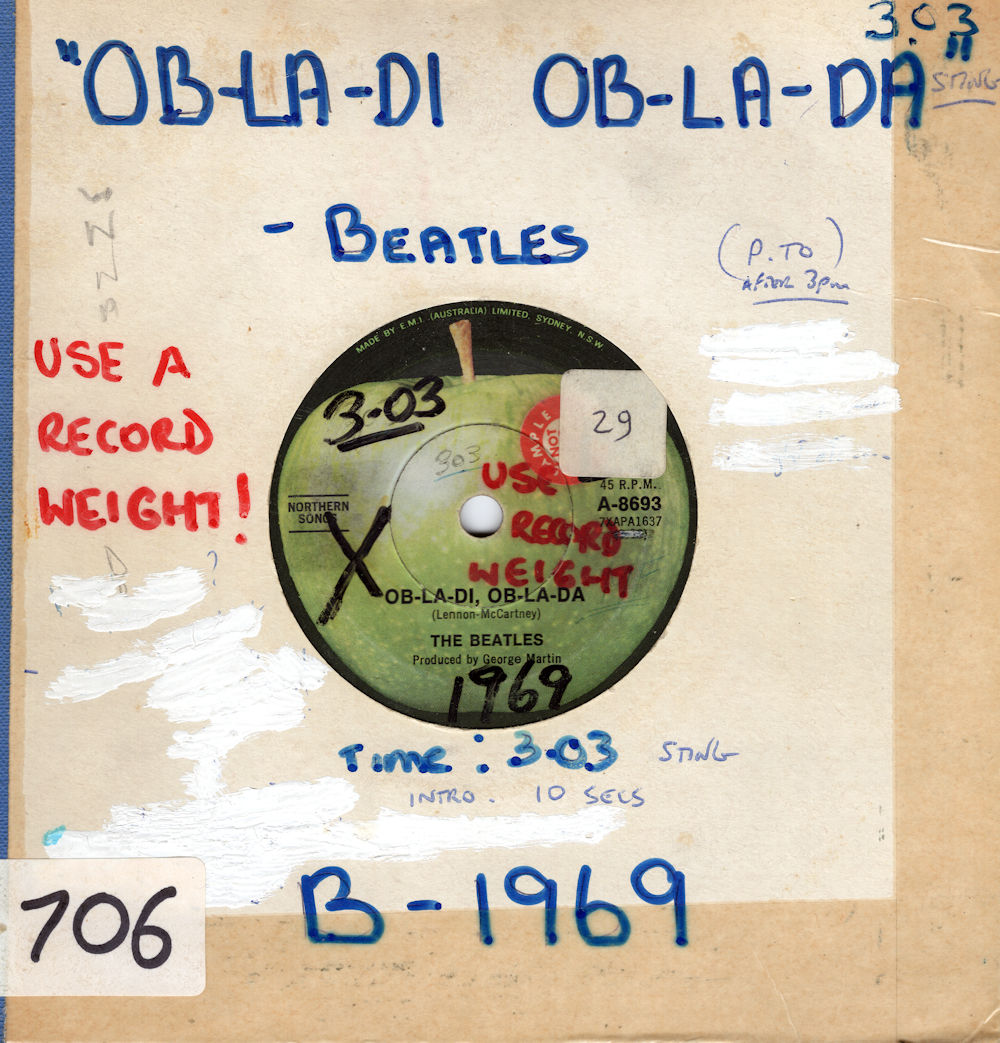
The two records above illustrate the extent to which commercial releases could be adapted for practical use inside a radio station. Records were commonly removed from their original paper sleeves and rehoused in heavier cardboard sleeves, which provided a durable surface for the station’s own cataloguing and announcer instructions. The spine could also be colour-coded with electrical or cloth tape according to the station’s filing system.

On 'I Feel Fine', the sleeve records the title, artist and year, together with a number of operational notes. “Time 2.17” is the station’s stopwatch-timed running time, which could differ from the duration printed on the record label. “Intro 12 secs” tells the announcer how long they had before the vocal began, while “Fades” indicates the manner in which the recording ends. The number 1029 formed part of the station’s own internal cataloguing system.

The pencilled “N W” indicates the periods in which the record was considered most suitable for programming: N = nights and W = “women’s”, the latter generally referring to the late-morning period around 10 a.m. to noon, when programmers assumed a predominantly female audience would be listening. Other shift codes could include B = breakfast, M = mornings, A = afternoons, D = drive and O/N = overnight. Some stations also used rubber date stamps to record when a disc had been played, sometimes alongside the relevant shift code. The exact nomenclature varied from station to station.

'Ob-La-Di, Ob-La-Da' shows additional types of instruction. “Sting” alerts the announcer to the song’s false ending, where the recording stops, briefly restarts and then finishes. The large X indicates the side approved for broadcast. The handwritten instruction “USE A RECORD WEIGHT” directed the announcer to place a weight over the turntable spindle to prevent the disc slipping on start-up. Records were often tightly cued for instantaneous playback, and any movement as the turntable accelerated could result in the opening of the record audibly slurring on air. The number 706 is again part of the station’s internal cataloguing system.

There were many variations on these markings and codes, but because announcers and programmers frequently moved between stations, a degree of practical uniformity gradually developed in the way records were prepared, timed and annotated for broadcast use.

Boxes of new releases
Not every promotional record arrived individually.

Record companies also supplied stations with boxes containing their current releases, sometimes with one copy of each new single.

A useful later example comes from a community radio station in Toowoomba during the second half of the 1980s. Following a visit to WEA Records’ Brisbane office near Milton Road at Auchenflower, an arrangement was made with the company’s promotions department for the station to receive regular consignments of new singles.

Approximately once a month, a box of 45s arrived representing WEA’s current promotional output.

Not every record was necessarily suited to the station’s format, but that was not really the point. The record company was ensuring that its new product physically reached broadcasters who might potentially play it.

The relationship continued into the period when compact discs were rapidly replacing vinyl. During one visit, a promotional copy of George Harrison’s Cloud Nine was also supplied, placing the episode around 1987.

As CDs became the preferred promotional format, the familiar boxes of promotional 45s gradually disappeared.

Promotion was about relationships
The promotional representative’s role extended well beyond simply delivering records.

Music Directors could receive a wide variety of promotional items — pens, letter openers, desk clocks and other branded objects — intended to keep a particular artist, release or record company in mind.

Some were practical. Others were deliberately inventive.

They formed part of the continuing relationship between record companies and the people responsible for deciding what went to air: partly an acknowledgement of existing support and partly an encouragement to consider future releases.

Promotional staff and Program Directors could also organise on-air promotions around particular artists or records in the larger markets. This might involve interviews, competitions, giveaways or other activity designed to generate additional attention around a release.

Competition between stations could be intense, particularly when a new record by a major artist was imminent. The Beatles were an obvious example. Imported UK sample copies could sometimes be flown into Australia ahead of the locally manufactured release, giving a station that obtained one the opportunity to put a new Beatles recording to air before its rivals. The same scramble occurred with other major acts: being first with an eagerly awaited record had promotional value for the station as well as for the record company.

Jeffrey Black recalls the extraordinary lengths to which Brisbane stations could go during the height of Beatlemania. When 4BC obtained a new Beatles release ahead of rival 4BH, 4BH reportedly recorded the song directly from 4BC’s broadcast so that it too could put the record to air. Once 4BC announcers realised what was happening, they began talking over the opening of the vocals to frustrate the practice.

The rivalry apparently reached its most mischievous point with 'She Loves You'. Jeffrey recalls 4BC announcers adding their own vocal interjections around the famous “yeah, yeah, yeah” refrain; when 4BH recorded the broadcast and replayed it, the 4BC announcers’ additions went to air with the record — much to the amusement of their rivals!

Albums could likewise be supplied urgently when a release was considered sufficiently important.

When Michael Jackson’s Bad was released in 1987, for example, a copy was reportedly dispatched to 4GR by bus. Rather than waiting for it to reach Toowoomba, the station’s Music Director drove out to meet the incoming bus part-way and returned immediately to the station so the album could be put to air as quickly as possible.

These episodes illustrate just how competitive radio could become around a major new release. For the biggest artists, obtaining and broadcasting a record even a few hours ahead of a rival could itself become part of the promotion.

Being the first station to play an eagerly awaited record had promotional value of its own.

A Beatles case study: Greatest Hits Vols 1 & 2
The 1973 Australian double album The Beatles Greatest Hits Vols 1 & 2 provides a particularly clear example of how record-company and radio promotion could work together.

The project originated with Sydney station 2UE, whose program manager Nick Erby approached EMI (Australia) while planning celebrations for the tenth anniversary of The Beatles’ first Australian record release. EMI repackaged the two existing Australian Greatest Hits albums as a limited-edition double set, while 2UE mounted an extensive on-air campaign around its release.

Anniversary-week programming included a one-hour Bob Rogers Beatles special and listener competitions, with prizes including two complete sets of the group’s album catalogue. The campaign was subsequently extended through member stations of the Major Radio Network of Australia, including 2KO, 3DB, 4BK, 5AD, 6PR, 7EX and 7HT.

Most unusually, copies distributed through the campaign carried a gold-foil sticker bearing the call sign of the participating radio station. The surviving sleeves therefore provide tangible evidence of the relationship between EMI (Australia), the radio network and individual broadcasters — something that is normally much harder to document from the finished record alone.

Read the full release history
→ The Beatles Greatest Hits Vols 1 & 2.

Promotional Beatles singles
The earliest Australian Beatles promotional singles were not manufactured with special promotional labels.

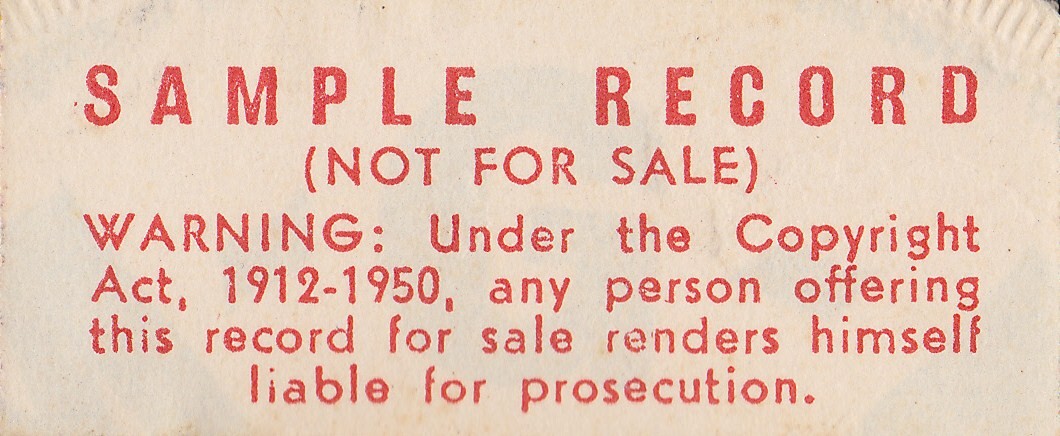
Promo copies of 'Please Please Me'/'Ask Me Why' used an ordinary production label with a rectangular sticker affixed to the A-side stating “SAMPLE RECORD (NOT FOR SALE)”, together with a copyright warning.

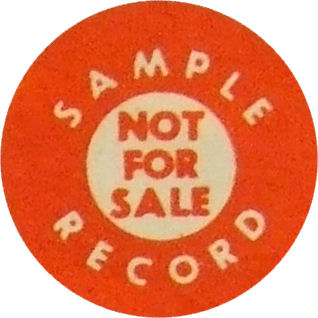
Before the release of 'From Me To You'/'Thank You Girl' in May 1963, this rectangular sticker was replaced by a round red-and-white sticker — now commonly referred to by collectors as the “bullet sticker” — carrying the simpler wording “SAMPLE RECORD NOT FOR SALE”.

The bullet sticker remained the characteristic identifying feature of Australian Beatles promotional singles through to 'Strawberry Fields Forever'/'Penny Lane'.
From 'All You Need Is Love'/'Baby, You're A Rich Man' in July 1967, EMI (Australia) produced special promotional pressings of Beatles singles carrying a distinctive “A” marking on the label, identifying the nominated plug side for radio and promotional use.

This practice continued through 'Hello, Goodbye'/'I Am The Walrus' and 'Lady Madonna'/'The Inner Light', after which Beatles singles reverted to normal commercial labels for promotional distribution. The special A-label format returned during EMI (Australia)’s renewed Beatles activity in the 1970s, including the 1976 singles 'Yesterday'/'I Should Have Known Better' and 'Got To Get You Into My Life'/'Helter Skelter', and again for the 1978 'Sgt. Pepper’s Lonely Hearts Club Band/With A Little Help From My Friends'/'A Day In The Life' single.

These records are useful surviving examples of how EMI (Australia) distinguished copies intended specifically for promotional servicing from normal retail stock. Rather than representing separate commercial issues, they formed part of the machinery by which EMI (Australia) supplied radio stations and other media outlets with material it wanted placed before listeners.

Promotional Beatles EPs

Australian promotional Beatles EPs followed the same general system.

A regular production copy was used, with the red-and-white “SAMPLE RECORD NOT FOR SALE” bullet sticker affixed to the side-one label.

Dedicated promotional EPs appear considerably less frequently than singles, reflecting the lesser importance of the EP format to commercial radio programming.

Promotional Beatles LPs
Throughout much of the 1960s and 1970s, Australian promotional Beatles LPs likewise generally used standard production labels with the red-and-white bullet sticker affixed to the side-one label.

Promotional LPs appear to have been distributed more selectively than singles.

Around 1980, EMI (Australia) adopted a different approach. Promotional LPs began appearing with specially printed labels using wording similar to that already employed on promotional singles. Stickers stating “SAMPLE RECORD NOT FOR SALE — FOR PROMOTIONAL USE ONLY” were also affixed to album sleeves.

The transition reflects the broader evolution of promotional practice as radio formats changed and LP-oriented programming became increasingly important.
Not every promotional copy looked like one
The existence of dedicated Beatles promotional variants can create a misleading impression that every record supplied to radio must have carried some obvious identifying mark.

That was almost certainly not the case.

Because EMI (Australia) routinely serviced radio stations with new 7-inch releases, a commercial pressing could be supplied for promotional use without ever being manufactured as a dedicated promo copy. Additional stock copies could also be left by promotion or sales representatives when they were actively pushing a particular release.

This distinction is important.

There is a difference between a purpose-manufactured promotional pressing and a commercial pressing supplied by the record company for promotional use.

From a collector’s perspective, the first can usually be identified. The second may be impossible to distinguish from a copy purchased over the counter.

This may help explain why some Australian Beatles and solo releases have well-documented promotional variants while others apparently do not.

Promotional 12-Inch singles
By the 1980s, the promotional 12-inch single had also become an increasingly important tool.

The larger format allowed record companies to distribute particular tracks to radio without necessarily creating a dedicated promotional edition of the commercial seven-inch single. A promotional 12-inch might contain the standard commercial version, an extended mix, an alternate mix or simply provide broadcasters with a convenient format for airplay.

As record promotion evolved, therefore, the existence — or non-existence — of a seven-inch promotional edition cannot always be considered in isolation.

Press kits and promotional material
Records were only one component of record-company promotion.

Press kits were generally directed more towards newspapers, magazines and other members of the print media. They could contain artist biographies, press releases, photographs, release information, tour details and other material intended to assist journalists preparing stories.

Radio stations also received written publicity material, particularly for major artists and releases, although conventional press kits appear to have been more closely associated with the print media.

Australian Beatles and solo press material therefore represents a related but distinct area of promotional activity.

A particularly elaborate Australian example accompanied the release of The Number Ones in May 1983. EMI (Australia) assembled a promotional pack in a cardboard wallet containing sample copies of the album and accompanying EP, a four-page typed summary of Australian Beatles releases, promotional photographs, stickers, a pin badge and an in-store promotional card.

The package demonstrates how promotional material could bring together the recording itself with background information, photographs and merchandising material, giving media and promotional staff a ready-made collection of material with which to support a major release.

Read more and view the surviving promotional material
→ The Number Ones — Promotional Material

An incomplete paper trail
One of the difficulties in documenting Australian promotional records is that much of the process left very little permanent evidence.

The records survive.

The stickers survive.

Occasionally envelopes, letters, press releases, mailing lists and complete press kits survive.

What generally does not survive is the everyday activity behind them: regular batches of new releases being sent out to stations, a promotion representative walking into a major broadcaster carrying additional copies of a priority single, or a regional sales representative adding radio promotion to the normal round of retail calls.

That routine may ultimately be just as important as the records themselves.

Understanding how EMI (Australia) organised its promotional department — how releases were selected for additional promotion, how stations were serviced, how many copies were supplied, when ordinary stock copies were used, and how promotion differed between metropolitan and regional markets — may help resolve some of the unanswered questions surrounding Australian Beatles promotional records.

For that reason, the history of Beatles promotional releases in Australia should not be viewed simply as a catalogue of unusual labels and stickers.

It was part of a much larger system involving record companies, promotion representatives, sales staff, radio programmers, librarians, announcers and journalists — and somewhere within that largely undocumented process may lie the explanation for why some Australian Beatles promotional records are familiar today while others apparently never existed at all.