Made in Australia

How EMI manufactured The Beatles’ records in Australia

For almost three decades, most Beatles records sold in Australia were manufactured locally by EMI (Australia). From mastering and pressing through to label printing, sleeve production, assembly and distribution, local manufacture gave these releases their distinctly Australian characteristics—and sometimes unexpected variations.

Behind every Australian Beatles record was an extensive manufacturing operation involving recording engineers, mastering technicians, factory workers, printers, designers and distribution staff. Although the recordings themselves generally originated in Britain, the records purchased by Australian fans were often produced almost entirely in Australia.

This article traces the development of EMI's Australian manufacturing operations, explains how British recordings became Australian releases and explores how the processes involved contributed to the many variations now studied by collectors.

The beginnings of local manufacture
By the mid-1920s, Australian demand for gramophone records had grown beyond what could reliably be supplied from overseas. In response, Britain's Gramophone Company Ltd opened a 40,000-square-foot gramophone and record factory at Erskineville, Sydney, on 18 January 1926. Employing approximately 400 staff, together with a manager and twelve departmental heads brought from Britain, the plant manufactured His Master's Voice gramophones and records for the Australian and New Zealand markets.

Nine months later, on 14 October 1926, rival Columbia Graphophone Company Ltd officially opened its own Australian factory at Homebush, Sydney. Operated through Columbia Graphophone (Australia) Ltd, the new 50,000-square-foot plant employed approximately 350 people.

Both factories represented substantial investments in local manufacturing at a time when the Australian record market had previously depended heavily upon imported products.

The formation of EMI
On 20 March 1931, amid the economic pressures of the Great Depression, the Gramophone Company Ltd and Columbia Graphophone Company Ltd—including its subsidiary, the Parlophone Company Ltd—merged in Britain to form Electric and Musical Industries Ltd, better known as EMI.

Their Australian operations were brought under a single administrative structure as the "associated manufacturers". Record production was consolidated at Columbia's Homebush factory from July 1931, ending record manufacture at Erskineville and establishing the site that would remain at the centre of EMI's Australian manufacturing operations for almost six decades.

The consolidation brought together the manufacture of His Master's Voice, Columbia, Parlophone, Regal Zonophone and other associated labels. It also allowed the company to rationalise its pressing equipment, metal-processing facilities, warehousing and distribution.

In 1936, EMI's Australian operation began manufacturing and distributing records under licence from Britain's Decca Records, following licensing arrangements established the previous year. Although Decca and EMI were competing record companies in Britain, their Australian relationship saw Decca recordings manufactured at EMI's Homebush factory. The arrangement was modified in 1954, when the American Decca catalogue shifted to Festival Records. EMI (Australia) continued manufacturing and distributing British Decca recordings in Australia until June 1981, when distribution rights transferred to PolyGram.

Although the British companies had merged, their established names continued to be used in Australia for many years. EMI (Australia) was formed as a proprietary company in 1948 to assume the activities previously conducted by the Australian branches of the British companies. The transition to the EMI name was gradual, with the former trading identities continuing to appear in some advertisements and business activities during 1949.

The company's headquarters were housed in the eight-storey Emitron House at 301 Castlereagh Street, Sydney. EMI (Australia) became a public company in May 1957.

By 1963, EMI (Australia) manufactured and distributed an extensive range of products, including televisions, radios, radiograms, car radios, domestic electrical appliances and, of course, gramophone records. Its records appeared on the company's principal HMV, Columbia and Parlophone labels, while the Homebush factory also manufactured records on behalf of Britain's Decca Records.

The Homebush factory
Manufacturing and distribution were centred at Homebush, where the original factory was progressively extended as EMI (Australia)'s activities expanded.

The plant originally contained twenty of the most advanced record presses then available. Imported from Britain and installed by British engineers, they were collectively capable of producing approximately eleven million records each year.

The introduction of microgroove records brought major changes to the manufacturing process. In May 1952, EMI (Australia) announced plans to commence large-scale Australian production of 33
⅓ rpm long-playing records and 45 rpm singles later that year, with manufacture expected to begin around November.

The new formats required different pressing procedures, vinyl compounds, metal components and inspection standards from those used for conventional 78 rpm shellac records. For several years, the older and newer formats were manufactured alongside one another as Australian consumers gradually adopted microgroove record players.

EMI (Australia) continued to draw upon British expertise and equipment throughout its history. By the time The Beatles were filling Australian homes with their music in the 1960s, the Homebush factory was using pressing equipment similar to that employed at EMI's plant at Hayes, Middlesex.

Homebush was much more than a record-pressing plant. Its operations included metal processing, electroplating, stamper production, pressing, quality control, packaging, warehousing and national distribution. The factory also employed engineers, toolmakers and maintenance staff responsible for keeping its extensive industrial equipment operating.

The scale of the operation allowed EMI (Australia) to manufacture substantial quantities of records for its own labels and, when capacity permitted, undertake work for other record companies and independent producers.

Recording and mastering at Castlereagh Street
An important change occurred in 1954 when EMI (Australia) transferred its principal Sydney recording studios from Homebush to its headquarters at 301 Castlereagh Street.

The new complex, initially known as EMI Studios, contained three principal recording rooms—Studios A, B and C—together with disc-mastering facilities.

The relocation established a distinction between the preparation of recordings and their physical manufacture. The Castlereagh Street studios undertook recording, editing and mastering, while Homebush remained responsible for preparing metal pressing components, manufacturing records, packaging and distribution.

During The Beatles' recording career, Australian disc masters could therefore be cut at the city studios, while the resulting metal components were used to manufacture records at Homebush.

However, not every Australian release was necessarily produced from a locally cut master. EMI (Australia) could also use metal parts supplied from Britain, depending upon the source material, production requirements and availability of suitable components.

This distinction is important when examining the matrix inscriptions and sound characteristics of Australian Beatles pressings.

The Castlereagh Street recording complex was extensively rebuilt in 1978 and subsequently became known as Studios 301.

Releasing The Beatles in Australia
As a subsidiary of EMI UK, EMI (Australia) received advance notice of forthcoming UK releases. It could then choose to import the finished product, manufacture an Australian edition or pass on the release altogether—the last option generally being available only when a title had not charted strongly in the UK.

Most Beatles records were manufactured locally and released on EMI's Parlophone label. Alongside the principal British catalogue, EMI (Australia) also devised numerous releases specifically for the local market. The company quickly discovered that, where The Beatles were concerned, more releases were better than fewer.

Between 1963 and 1970, EMI (Australia) released 30 Beatles singles, including 18 double A-sides, together with 18 EPs and 17 LPs. Over the same period, EMI in Britain released 22 singles, 13 EPs and 13 LPs.

The differences extended beyond the number of releases. Australian editions could have different catalogue numbers, release dates, track configurations, label designs and sleeves from their British counterparts.

Manufacturing decisions were also influenced by the availability of imported tapes or metal parts, local production schedules and the need to satisfy rapidly increasing demand.

The extraordinary popularity of The Beatles placed considerable pressure on EMI's Australian manufacturing and distribution operations. By 1964, advance orders for the Australian release of A Hard Day's Night demonstrated the scale of demand facing the company.

Producing a successful release involved coordinating the supply of suitable masters, the manufacture of records, the printing of labels and sleeves, and the distribution of finished stock to retailers across Australia.

These arrangements did not always produce entirely uniform results. Different pressing runs could employ different metal components, while changes in printers, labels and packaging materials introduced further variations.

Australian catalogue numbers
British Parlophone LPs adopted for Australian release generally retained their original catalogue numbers, with the Australian country code "O" added to the mono or stereo prefix. For example, the British catalogue number PMC 1202 became PMCO 1202 in Australia.

Albums issued locally that were not part of the British Parlophone catalogue were assigned numbers from a separate Australian series beginning at PMCO 7500 for mono and PCSO 7500 for stereo.

The same principle applied to EPs. British Parlophone EPs released in Australia retained their original numbers, with an "O" added to the GEP prefix. Locally compiled EPs—including British titles with modified track listings—were allocated numbers from an Australian series beginning at GEPO 70001.

Australian Parlophone singles originally used catalogue numbers in the A8000 series. From A8083, numbers ending in "3" were either allocated to, or reserved for, The Beatles.

In March 1968, EMI (Australia) replaced the separate numbering systems used by its house and distributed labels with a unified catalogue beginning at 8301. The 8000 series was selected because Parlophone's existing catalogue—the highest series then in use—had already reached the low 8000s.

'Lady Madonna'/'The Inner Light' was the final Parlophone single issued under the earlier numbering system.

Mono, stereo and other formats
EMI (Australia) manufactured LPs in both mono and stereo throughout most of the 1960s. Stereo recording had been introduced at the company's Sydney studios in 1958, although mono remained the dominant format for popular singles for much of the following decade.

Producing mono and stereo editions of the same album could require separate masters, metal components, labels and identifying details on the sleeves.

As demand for mono records declined, the company deleted mono editions of albums for which stereo alternatives existed in June 1969. By then, the mono editions of The Beatles and Yellow Submarine had sold only approximately 5,000 and 1,300 copies respectively.

Locally manufactured pre-recorded cassettes followed in 1970, with 8-track cartridges introduced around the middle of 1972. All Beatles LPs were subsequently released in both formats, although the Yellow Submarine 8-track cartridge was available through import only.

As in Britain, cassette and 8-track editions were not necessarily mastered from the same tapes as their vinyl counterparts. It was therefore possible—and quite likely—for different formats of the same album to have been prepared from different sets of tapes.

The introduction of new formats also expanded the manufacturing activities undertaken at Homebush. Cassette production required high-speed duplication, tape loading, shell labelling, the printing of inserts and final packaging, rather than the metal-processing and pressing procedures employed for vinyl records.

Inside the Homebush factory
Manufacturing a record involved considerably more than pressing vinyl.

Before a finished record could reach a retailer, the recording had to be prepared for manufacture, suitable metal components produced, records pressed and inspected, and printed labels and sleeves supplied. The finished records were then assembled, packed and distributed.

At EMI (Australia), these activities were undertaken by specialised departments and a network of external suppliers. Mastering engineers prepared lacquer masters, electroplating technicians produced metal components, factory employees operated the presses and assembly staff matched records with their packaging.

The following photographs offer a glimpse of the people, equipment and working practices behind EMI (Australia)'s records.

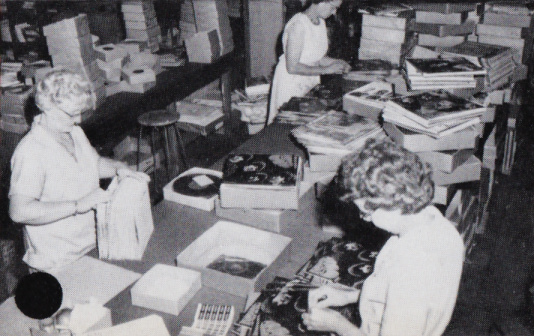
Assembling copies of Rubber Soul
EMI (Australia) employees match copies of Rubber Soul with their sleeves. Boxes containing records can be seen throughout the work area, including behind the employees and beneath the bench.

The employee on the left sorts through a bundle of sleeves, while the employee at the lower right applies stereo stickers to her batch. The stickers are visible on the table in front of her, and the employee in the background appears to be carrying out the same task. At the rear left are what appear to be bundles of 7-inch records in generic EMI sleeves.

The crowded work area, with boxes and bundles positioned around the employees, helps explain the sometimes unpredictable combinations of records and sleeves found by collectors. Staff worked with the stocks available to them, drawing records and sleeves from whichever boxes were at hand rather than necessarily following a strict production sequence.

These working practices help explain the irregular distribution of numbered sleeves for The Beatles, as well as why late-1969 copies of Sgt. Pepper’s Lonely Hearts Club Band could still be supplied in British-made sleeves after an Australian sleeve had become available. Once assembled, the records were packed into boxes of 25 and sent to the warehouse.

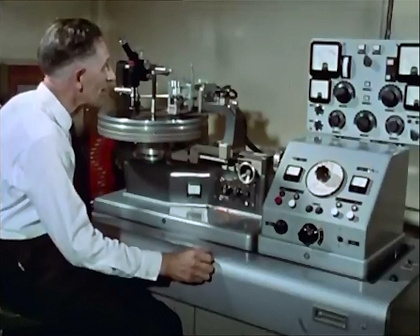
Jack Ashford at the mastering lathe, circa early 1969
EMI (Australia) mastering engineer Jack Ashford operates a Neumann AM-32b master disc-cutting lathe fitted with an Ortofon cutter head.

Jack was a longstanding member of EMI (Australia)'s technical staff, his career extending back to the era of cylinder recordings. He retired through ill health in 1972 and was succeeded by a young Warren Barnett.

The lathe dated from the 1950s and may have been installed when EMI (Australia) built its new recording studios at Castlereagh Street in 1954.

Mastering represented an essential stage in record manufacture. A suitable tape source was used to cut a master disc, from which metal components could be produced for pressing. The quality of the original cut, together with subsequent processing and pressing, could influence the sound of the finished record.

For Australian Beatles releases, identifying whether a record was manufactured from a locally cut master or imported metal parts is an important part of researching pressing variations.

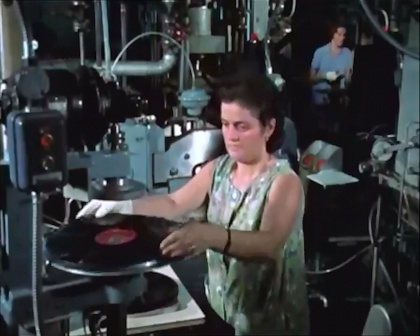
Record pressing at Homebush, early 1969
 
An employee presses records at EMI (Australia)'s Homebush factory. The photograph shows the hands-on nature of record manufacture before the later introduction of automatic pressing equipment.

Record manufacture depended upon carefully prepared metal stampers, suitable vinyl compounds and the accurate operation of the presses. The stampers carried the grooves that would be reproduced on each finished record, while record labels were incorporated during the pressing process.

Individual pressings were subject to inspection and quality-control procedures designed to identify manufacturing faults.

High-demand releases could require numerous production runs and multiple sets of stampers. Worn or damaged metal components eventually had to be replaced, and in some circumstances an entirely new master could be cut.

Such changes are among the reasons why apparently identical Australian Beatles releases can be found with different matrix inscriptions or other manufacturing characteristics.

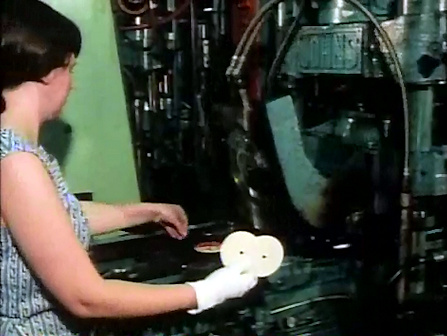
A Johns record press in operation, 1979

One of EMI (Australia)'s Johns presses in operation at Homebush, shortly before the installation of new Toshiba-EMI automatic presses.


The Australian-made Johns manual hydraulic press was a workhorse of EMI (Australia)'s manufacturing operation. In use since the late 1950s, these presses served the company throughout the peak years of Beatles record production and into the late 1970s.


Their continued operation illustrates the longevity of the equipment used to manufacture Australian records. Although mastering techniques, vinyl compounds and other production processes evolved, much of the company's pressing infrastructure remained in service for many years.


Labels, sleeves and packaging

Although EMI (Australia) manufactured the records themselves, producing the finished product required a substantial network of specialist printers and packaging suppliers.


These businesses supplied record labels, LP and EP sleeves, printing plates, photographic reproduction, cardboard packaging and other materials essential to commercial record manufacture.


Among the companies associated with EMI (Australia) were H. Clark Pty Ltd, Bookcraft Printing Pty Ltd, F. H. Booth & Son Pty Ltd and Z. Nosek & Co Pty Ltd.


Their work formed an important part of EMI's Australian record-manufacturing operation, even though the companies themselves were generally less visible to consumers than the record labels.


During the late 1960s EMI (Australia) acquired H. Clark Pty Ltd, bringing an established printing supplier under company ownership while retaining its existing business identity.


The introduction of more elaborate LP packaging also increased the importance of specialist printing techniques. Z. Nosek & Co, for example, became associated with the production of Australian gatefold record sleeves during the late 1960s.


The existence of multiple suppliers helps explain why different Australian editions, and sometimes different copies of the same edition, can be found with variations in sleeve construction, paper stock, printing, typefaces and other details.


Labels and sleeves were not necessarily manufactured in the same quantities or at the same time as the records themselves. Existing stocks could remain in use while new designs or revised printing arrangements were introduced.


Consequently, changes to a label or sleeve did not always occur simultaneously with changes to the record's metal parts or other manufacturing characteristics.


Further information about these differences can be found in the Label Styles and Sleeve Manufacturing sections.


Understanding Australian pressing variations

Many of the variations now sought by Beatles collectors arose from normal manufacturing practices rather than deliberate attempts to produce different editions.


A successful release might remain in production for years, during which several aspects of the manufacturing process could change.


A record might require replacement stampers after the original components became worn or damaged. A new lacquer master might be cut from a different source tape, while labels could be reprinted using revised typography or layouts.


Sleeve manufacture could also change independently. Different printers might be engaged, new materials introduced or existing stocks used alongside newly printed packaging.


Even the assembly process could produce unexpected combinations, particularly when records and sleeves from different production runs were available simultaneously.


The resulting variations may be reflected in:

  • Matrix numbers and dead-wax inscriptions;
  • Machine-stamped or handwritten markings;
  • Label designs, typefaces and printing details;
  • Sleeve construction and printing characteristics;
  • Stereo stickers and other packaging materials;
  • Differences in the mastering or sound of particular pressings.

These details are valuable evidence when attempting to establish the manufacturing history of an Australian release.


However, an individual variation does not necessarily establish a precise pressing date. Matrix inscriptions, labels, sleeves and other features must be considered together, particularly where older manufacturing components or packaging stocks remained in use.


The study of Australian Beatles records is therefore as much a study of EMI's manufacturing practices as it is of the records themselves.


An evolving Australian operation

Throughout the 1960s and 1970s, EMI (Australia) continued to adapt its mastering, pressing, printing and packaging operations to changing technology and increasing demand.


The Homebush factory remained one of Australia's major record-manufacturing centres, producing discs for EMI's own labels as well as undertaking contract work for other companies and independent producers.


A survey of the Australian recording industry published in Billboard in 1979 reported that EMI (Australia) employed approximately 438 people. The same report attributed a daily manufacturing capacity of approximately 25,000 albums, 7,000 singles and 12,000 cassettes to the Homebush operation.


These figures represented reported production capacity rather than necessarily the quantities manufactured on any particular day. Nevertheless, they illustrate the considerable scale of EMI's Australian manufacturing activities at the end of the 1970s.


The company's pressing facilities continued to evolve, with new equipment supplementing or replacing machinery that had been in service for many years.


In 1984, EMI and CBS established a joint distribution operation known as Entertainment Distributors, combining aspects of warehousing, dispatch and administration while remaining separate record companies.


By the middle of the decade, the Homebush plant was still sufficiently busy that capacity constraints affected its ability to undertake custom manufacturing. In 1986, Studios 301 temporarily suspended its custom-pressing service because the factory could not accommodate the additional work.


Nevertheless, the rapid growth of the compact disc presented a significant challenge.


Unlike vinyl records, compact discs required an entirely different manufacturing process involving specialised mastering, moulding and optical-disc production equipment. EMI's Australian CD releases were initially manufactured overseas rather than at Homebush.


Although vinyl records and cassettes remained important throughout much of the 1980s, the increasing popularity of compact discs gradually changed the economics of maintaining a large Australian record-pressing plant.


Vinyl and cassette manufacture at Homebush ceased in November 1990, bringing to an end approximately 64 years of record manufacturing at the site.


Accounts identify 1992 as the broader closure date for the Homebush factory, reflecting a distinction between the termination of record production and the eventual cessation of remaining site activities. EMI (Australia) subsequently sold the property in 1994.


By then, the company no longer needed to manufacture every record it released. Recording, mastering, manufacturing and distribution could be undertaken at separate facilities, including those operated by other companies.


The vertically integrated manufacturing organisation that had begun at Homebush in 1926 had fundamentally changed.


A distinctly Australian legacy

For Australian Beatles collectors, the significance of EMI (Australia)'s manufacturing history extends well beyond the Homebush factory itself.


The records produced there reflect almost every stage of the company's industrial operations: the preparation of local masters, the use of imported metal components, changes to pressing equipment, the involvement of specialist printers and the practical realities of assembling and distributing large quantities of records.


These processes left their mark on the finished products.


Label designs, typefaces, matrix numbers, sleeves, stickers and packaging combinations now provide valuable evidence of when—and sometimes how—individual records were manufactured.


What might appear to be a minor difference between two copies of the same Beatles album can reveal something about the people, equipment and procedures involved in producing them.


Together, these details form the distinctly Australian manufacturing history behind The Beatles' locally released catalogue.


Explore the related pages for more about EMI (Australia)'s mastering, pressing, printing, packaging and contract-manufacturing operations.