YELLOW SUBMARINE
Apple PMCO 7070 / PCSO 7070
Released 23 January 1969
Original recommended retail price: $5.50
Released in Australia on 23 January 1969, Yellow Submarine was the final Beatles album issued locally in mono, with that scarce edition selling only around 1,300 copies before the album later became notable for EMI (Australia)’s limited 1987 yellow-vinyl reissue.
Labels & Related Material
AULP7070A
January 1969
AULP7070NZCC
January-June 1981
AULP7070SBA
April 1982
AULP7070SBB
July 1987
Tracks
Same tracks as UK release
Pressing & Mastering

Format

First Issued

Side 1

Side 2

Parts

Mono

23-Jan-69

XEX 715-1

XEX 716-1

UK

Stereo

23-Jan-69

YEX 715-1

YEX 716-1

UK

Stereo

Apr-81

YEX 715-2 ✎OR

YEX 716-2 ✎OR

AU

Stereo

24-Aug-87

✎PCSO 7070 A-2 AP

✦MASTERED ON COPPER

✎PCSO 7070 B-2 AP

✦MASTERED ON COPPER

AU*

Stereo

19-Dec-88

✎PCSO 7070D-A

✎PCSO7070D-B

AU

*Yellow vinyl pressing; mastered direct to copper. Only 2,000 pressed
Sleeve Information

Code

Circulated

Comments

AU1

Jan-69

Mono + stereo catalogue numbers; flipback sleeve; front laminated

AU2

Dec-69

Stereo catalogue number only; non-flipback sleeve

AU3

Dec-88

"DIGITALLY REMASTERED" footer on rear cover

Overview
Yellow Submarine marked the end of original mono album releases by The Beatles in Australia, as it did in Britain. Its mono recording was not a separate dedicated mix, but a fold-down of the stereo tapes.

Demand for mono had fallen sharply. EMI (Australia) began deleting mono records where stereo alternatives existed in December 1968, and Bruce Hamlin’s The Beatles Records in Australia records sales of only approximately 1,300 Australian mono copies of Yellow Submarine. Even within that small production run, at least two mono label variations appeared.

The paperwork almost gave the album the wrong label identity. Its Australian Acceptance Sheet specified Parlophone, but the error was corrected before manufacture. New Zealand’s paperwork appears to have contained the same instruction without correction, resulting in early New Zealand copies on Parlophone despite the preceding White Album having appeared on Apple.

The Australian artwork
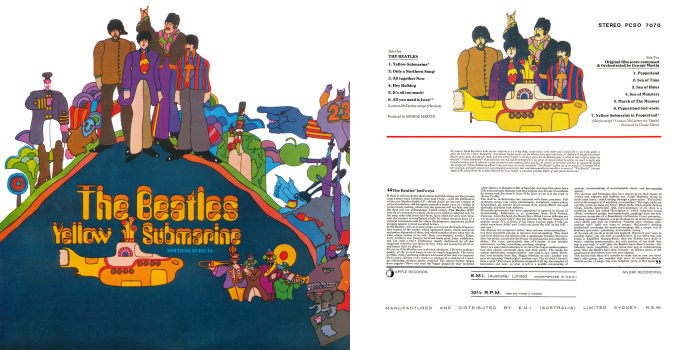
The local sleeve resembled the British design but differed in several details. The hill was blue-green rather than grey. The “NOTHING IS REAL” lettering changed font, position and colour, appearing in blue rather than green and slightly farther left. The two Blue Meanies at the lower right were grey instead of blue. On the rear, one horizontal line was red and locally reconstructed, while the other was black rather than the British red. Derek Taylor’s italicised text was centred horizontally instead of aligned left.

Around early 1987, a printing error shifted both front and rear artwork upwards by approximately 1.5 centimetres. Part of John’s head and arm disappeared at the top, while a white band appeared along the bottom. Subsequent print runs corrected the problem.

The 1987 yellow-vinyl edition
For the coloured reissue, Allan Parsons transferred the original analogue production tapes to Beta tape through a Sony PCM-701 digital converter. This early consumer system was inferior to the professional Sony 1610/1630 equipment, but represented EMI’s digital conversion method at the time.

It is assumed that Allan also adjusted equalisation and used dynamic-range processing during transfer; a dbx 3BX enhancer was present in the equipment rack. The precise processing is not confirmed. The digital transfer nevertheless makes this edition—and the contemporary white-vinyl White Album—a locally produced digital remaster, although not one sanctioned by EMI UK. Further background appears on The Beatles Production Master Tape page.

The recording was cut directly to copper using a process essentially equivalent to Direct Metal Mastering with minor modifications. Festival pressed the yellow records because EMI (Australia) did not manufacture coloured vinyl, and the edition appeared on 24 August 1987.

Its sound is considered disappointing, leaving its principal appeal in the coloured-vinyl presentation. The album nonetheless returned to the charts for seven weeks and reached No. 53, probably driven mainly by the CD release.

After the yellow run, EMI (Australia) resumed black-vinyl manufacture using Allan’s masters. Those remained in use until the new digital catalogue cuts replaced them in late 1988.