MAGICAL MYSTERY TOUR
World Record Club S/4574
Parlophone PCSO 3077
Released June 1969
Original recommended retail price: $3.35
First issued locally by the World Record Club in June 1969, Magical Mystery Tour followed an unusual Australian path through club editions, imported records and locally made tapes before EMI (Australia) finally began pressing its own LP edition in 1979.
Labels & Related Material
AULP4574WRCS
June 1969
AULP4574WRCT
August 1972
AULP2835US
September 1974
AULP3077OC
July 1979
AULP3077NZCC
January-June 1981
AULP3077SBA
April 1982
AULP3077SBB
July 1987
Tracks
Same tracks as US release
Pressing & Mastering

First Issued

Side 1

Side 2

Parts

Jun-69

✎SMAL-1-2835 B24 ✦IAM

✎SMAL-2-2835 A23#4 ✦IAM

US

23-Sep-74

✎SMAL-1-2835 H29.2

✎SMAL-2-2835 H31.2

US

16-Jul-79

PCSO.3077A

PCSO.3077B

AU

~82

✎PCSO.3077A-2

PCSO.3077B

AU

19-Dec-88

✎PCSO3077D-A

PB EMIDISC DMM

✎PCSO3077D-B

PB EMIDISC DMM

AU

Sleeve Information

Code

Circulated

Comments

AU1

Jun-69

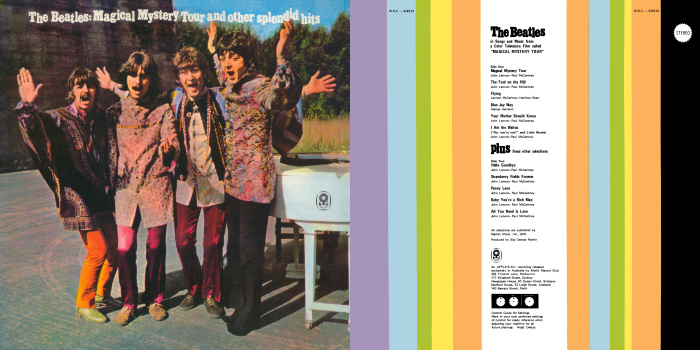
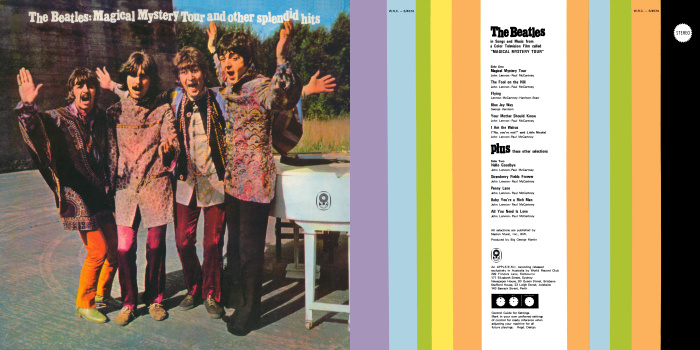
Front cover taken from page 10 of the US LP/UK EP booklet; non-gatefold. Rear has two yellow stripes. Titled Magical Mystery Tour And Other Splendid Hits

AU2

Late 72

Second yellow stripe on rear cover replaced with green (click the sleeve image above to view the inner gatefold)

US1

Sep-74

US import

AU3

Jul-79

Locally-produced (gatefold) version of US1 but without booklet (although some copies have been observed with a loose, unglued booklet included)

AU4

Dec-88

Same as A3 but with "DIGITALLY REMASTERED" footer on interior left gatefold

Overview
When the Australian World Record Club entered the pop market in 1969, it wanted a strong flagship release. Magical Mystery Tour supplied one: a well-known programme that, as the club advertised, had “never before [been] available in LP form in Australia”.

Co-founder John Day recalled that Repertoire Director Dianne Ellis discovered the album among a pile of mainly classical EMI records supplied during a routine Sydney visit. Surprised by its inclusion, she queried it and was told that EMI did not intend to release it locally: the club could have it if it wished.

The World Record Club issued the album in June 1969, adding “And Other Splendid Hits” to the title and giving it customary club-specific artwork. The cover used the photograph from page ten of the twenty-four-page booklet accompanying the EP and American LP. Records were pressed from American mothers supplied through Capitol’s Scranton, Pennsylvania plant. By all accounts, the release sold very strongly for the club.

An 8-track edition joined the club’s first cartridge releases in March 1970. A cassette followed in November as part of its first cassette range, housed in the hard plastic cases then used. Its early production master was simply an LP dub, preserving vinyl noise as well as the record’s duophonic tracks.

The programme continued through repeated LP, cassette, cartridge and reel-to-reel editions during the 1970s. The reel-to-reel edition appeared in May 1973. During 1973, a new production master containing true stereo versions of every track replaced the original source. This probably coincided with the reel release, one month before Britain’s stereo cassette edition, although the exact timing remains uncertain.

Meanwhile, EMI (Australia) faced continuing demand outside the club. Buyers could order American LP, cartridge and cassette editions through EMI’s international ordering system, although only the American cassette, 4XT 2835, appeared in local catalogues.

In September 1974, following EMI UK’s approach, EMI (Australia) began manufacturing its own cassette and formally added the album to its catalogue. Its title followed the British wording, adding “And Other Titles”. The cassette used the British production master assembled in the early 1970s, replacing Capitol’s duophonic recordings with true stereo mixes. LP and cartridge supplies continued to come from America.

The album entered the national charts for the first time in mid-October 1974, reaching No. 48 during thirteen weeks.

Domestic EMI LP manufacture finally began in July 1979. The local gatefold was of poorer quality than the overseas package and normally omitted the twenty-four-page booklet, although some copies included one loose. Until the digital era, the vinyl retained duophonic versions of ‘Penny Lane’, ‘Baby, You’re a Rich Man’ and ‘All You Need Is Love’, despite the earlier availability of true stereo tape editions.

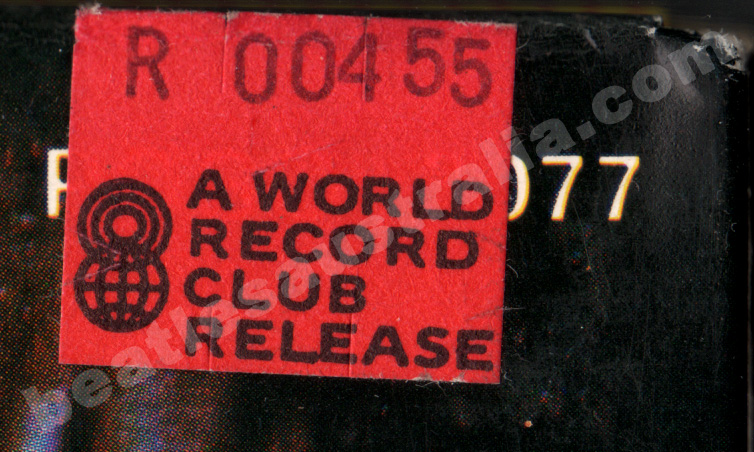
The World Record Club continued offering the album. Copies from late 1979 used EMI’s domestic Parlophone cut; from 1981, the club supplied the standard EMI (Australia) edition with a small World Record Club sticker covering the rear catalogue number. An example appears in the image below.