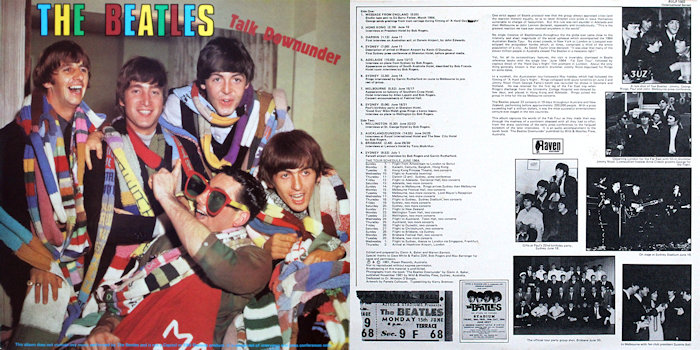
THE BEATLES TALK DOWNUNDER
Raven RVLP 1002
Released November 1981
Original recommended retail price:
Released by Raven in November 1981 as an audio companion to Glenn A. Baker’s book, The Beatles Talk Downunder traces the group’s 1964 Australasian tour through interviews, press conferences and spoken messages.
Labels & Related Material
AULP1002RVA
November 1981
Tracks

Side 1

Side 2

1. Message From England

1. Wellington

2. Hong Kong

2. Auckland/Dunedin

3. Darwin

3. Brisbane

4. Sydney

4. Sydney

5. Adelaide


6. Sydney


7. Melbourne


8. Sydney


Pressing & Mastering

First Issued

Side 1

Side 2

Parts

Nov-81

✎BTLS 1 RVLP 1002 A

✎BTLS 2 RVLP 1002 B

AU

Sleeve Information

Code

Circulated

Comments

AU1

Nov-81

Laminated sleeve

Overview
The Beatles Talk Downunder approached The Beatles’ Australian history through their voices rather than their songs. Issued in mono in November 1981, the nearly hour-long LP followed their 1964 Australasian tour through interviews, press conferences and recorded messages, serving as an audio companion to Glenn A. Baker’s illustrated book The Beatles Down Under: The 1964 Australia & New Zealand Tour.

The project suited Raven Records’ collecting and research interests. Established in Sydney in 1979 by Glenn, Kevin Mueller and Peter Shillito, Raven specialised in recovering rare or overlooked recordings. Its earliest releases explored Australian beat and garage rock, before it expanded into archival LP compilations in 1980. Agreements with Australian and overseas labels, together with arrangements made directly with artists, opened access to material that might otherwise have remained unavailable. Raven described its releases as “prepared by collectors for collectors” and continued operating until April 2017.

One of Raven’s earliest LPs, The Beatles Talk Downunder begins with a message recorded in England in March 1964 and ends with farewell interviews at Sydney Airport on 1 July. The sequence lets listeners follow the tour as a series of encounters, preserving the humour and immediacy of the group’s public appearances. Astor Records pressed the album only weeks before closing its manufacturing facility.

The release also travelled overseas, appearing on Goughsound in Britain, PVC Records in the United States, Passport Records in Canada and Trio Records in Japan. The Japanese edition used translucent green vinyl.

A later digital edition divided the programme into twelve sections organised by location. Those divisions do not necessarily correspond to the bands on the original LP.