PLEASE PLEASE ME
Parlophone PMCO 1202 / PCSO 3042
Released 17 October 1963 (mono), 9 April 1964 (stereo)
Original recommended retail price: 52/6
Released in Australia in October 1963, seven months after its British debut, Please Please Me arrived to little fanfare in a market where The Beatles had yet to achieve their breakthrough.
Labels & Related Material
AULP1202GA
October 1963
AULP1202GB
January 1964
AULP1202YBM
March 1964
AULP3042BS
April 1964
AULP1202NZCB
1967/68
AULP3042OA
Q3 1969
AULP3042OB
October 1978
AULP3042NZCC
January-June 1981
AULP3042SBA
April 1982
AULP3042SBB
July 1987
Tracks
Same tracks as UK release
Pressing & Mastering

Format

First Issued

Side 1

Side 2

Parts

Mono

17-Oct-63

XEX 421-1N

XEX 422-1N

UK

Stereo

09-Apr-64

YEX 94-1

YEX 95-1

UK

Stereo

05-Nov-80

YEX 94-2

YEX 95-1

AU/UK

Stereo

Aug-81

YEX 94-2

YEX 95-2

AU

Stereo

12-Dec-86

✎PCSO 3042 A-3 YEX 94-3

YEX 95-2

AU

Mono

19-Dec-88

✎PCSO 3042 D-A

PB - EMIDISC - DMM

✎PCSO 3042 D-B

PB - EMIDISC - DMM

AU

Sleeve Information

Code

Circulated

Comments

UK1

Oct-63

500 sleeves

AU1

Dec-63

Mono catalogue number only; flipback sleeve

AU2

Mar-64

Mono + stereo catalogue numbers; flipback sleeve

AU3

Dec-69

Stereo catalogue number only; non-flipback; stereo EMI footer on rear cover

AU4

Dec-80

UK replica sleeve; stereo catalogue number only; local EMI details on rear cover

AU5

Dec-88

UK replica sleeve; "DIGITALLY REMASTERED" footer on rear cover

Overview
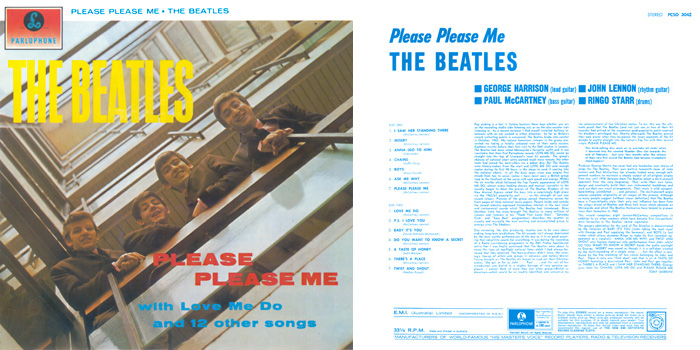
When Please Please Me reached Australia, EMI (Australia) was introducing a group whose commercial potential had yet to become clear locally. The cautious approach extended to its packaging: the first Australian records were housed in 500 sleeves imported from Britain, while the locally produced cover incorporated changes intended to keep manufacturing costs down.

The Australian front-cover photograph is noticeably brighter than the British original, revealing detail that disappears into shadow on the UK sleeve. This resulted from the local methods used to reproduce and print overseas artwork, rather than a deliberate photographic redesign. The With The Beatles page explains those production practices in greater detail.

The cyan—or blue—lettering on both sides of the Australian sleeve was another practical decision. Substituting cyan for black reduced the required printing blocks from four to three, saving approximately £50, or around $100, in set-up costs. That was a meaningful saving in 1963, particularly for an album by a group still largely unknown in Australia.

The local labels also adopted punctuation absent from familiar overseas versions. Where grammatically appropriate, Australian pressings listed ‘Please, Please Me’, ‘Love Me, Do’ and ‘Baby, It’s You’, corresponding to tracks 1.7, 2.1 and 2.3 respectively.

By December 1980, the original reasons for the distinctive Australian presentation had long since passed. EMI (Australia) replaced the local sleeve with a replica of the British design. Another change followed with the 1988 digitally remastered LP: although the recording was mono, matching the 1987 CD, it retained the stereo catalogue-numbering system.