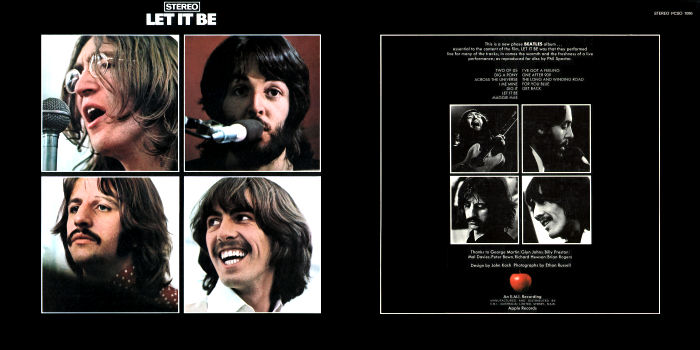
Let It Be
Apple PXS1/PCSO 7096
Released 4 June 1970 (box set), and December 1970 (LP only)
Original recommended retail price: $7.95
Initially released in Australia on 4 June 1970 as an elaborate box set containing the Get Back book, Let It Be became notorious for its fragile, cumbersome packaging, with the album subsequently issued separately from December 1970.
Labels & Related Material
AULP7096A
June 1970
AULP7096NZCC
January-June 1981
AULP7096SBA
April 1982
AULP7096SBB
July 1987
Tracks
Same tracks as UK release
Pressing & Mastering

First Issued

Side 1

Side 2

Parts

4-Jun-70

YEX 773-3U

YEX 774-3U

UK

1982

YEX 773-3U

✎YEX 774-2 AP

UK/AU

19-Dec-88

✎PCSO 7096 D-A

✎PCSO 7096D-B

AU

Sleeve Information

Code

Circulated

Comments

AU1

Jun-70

Front laminated. "STEREO" printed on front. Red Apple logo on rear

AU2

Dec-88

"DIGITALLY REMASTERED" footer on rear cover

Overview
Let It Be first reached Australian buyers as more than a record. The original package paired the LP with Get Back, a glossy soft-cover photographic book, housed in a complicated assembly of slipcovers and a shaped book tray.

Australian Record Collector, issue nineteen in 1996, aptly described it as an unwieldy collection of flimsy cardboard components: inner and outer slipcovers surrounding a tray specially designed to hold the book.

Only the LP itself and its sleeve were manufactured locally; all other components of the package were imported from Britain. The books carried a sticker on the credit page setting out the British publishing credits.

Warren Barnett recalls:
“During my first week at EMI in October 1969, I was asked to work the weekend unpacking shipping containers from an ACT 3 container ship. They contained thousands of Let It Be boxes and books, many months before the album’s eventual release.”

By March 1970, Apple faced a crowded release schedule, with Let It Be, McCartney and Ringo Starr’s Sentimental Journey competing for space alongside the recent Hey, Jude! compilation. John and George sought to postpone McCartney until June, but Paul refused. His album retained its 17 April UK release date, while Let It Be followed on 8 May.

Warren continues:
“The end result of those Apple 'discussions' was thousands of fully bagged Let It Be and McCartney albums piled up in the factory, cover store and warehouse. Let It Be was a particular problem because of its size and weight. There was also a last-minute alteration to the book: a new credits page had to be printed and pasted over the original page in the UK-printed book. Some got through without the replacement page, though.”

The elaborate presentation was also its weakness. Even careful opening could tear, dent or crease the thin card, and repeated handling made matters worse. As Australian Record Collector observed, some owners lost patience with its cumbersome construction, kept the LP and discarded the remaining packaging without considering future collectability.

The difficulties began before the sets reached buyers, as David Lillicot, then record buyer for Nicholson’s—at the time Australia’s largest record store—recalled:
"I was the record buyer for Nicholson's, the biggest record store in Australia at that time. When Let It Be was released we had so many problems with torn outer packaging. It was a nightmare trying to get un-damaged product from EMI (Australia)!".

Complete boxes have therefore never been inherently rare, but pristine examples are a different proposition. Their condition reflects both the fragility of the materials and the frustration of using the original design.

From December 1970, the album became available separately, removing the troublesome book package from the purchase. All Australian-manufactured LP sleeves retained the red Apple symbol on the rear.