Released June 1964 Original recommended retail price: 15/6
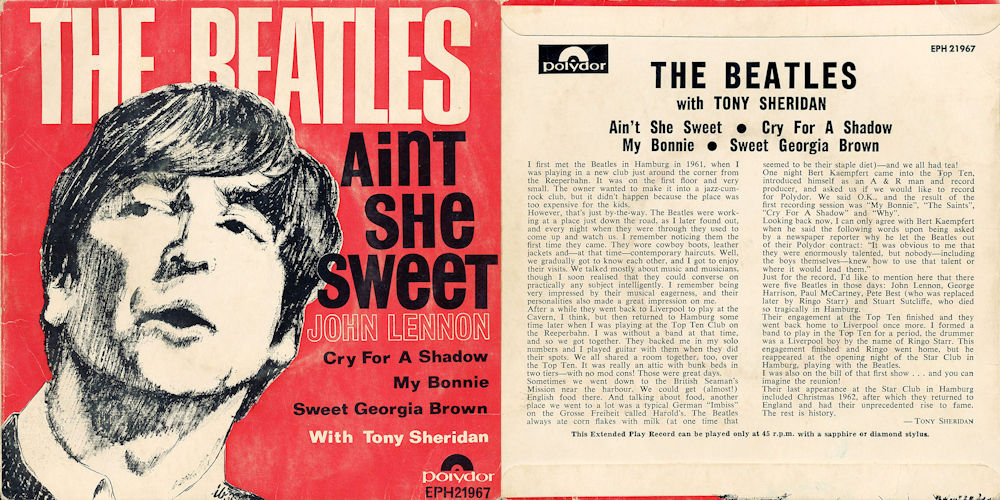
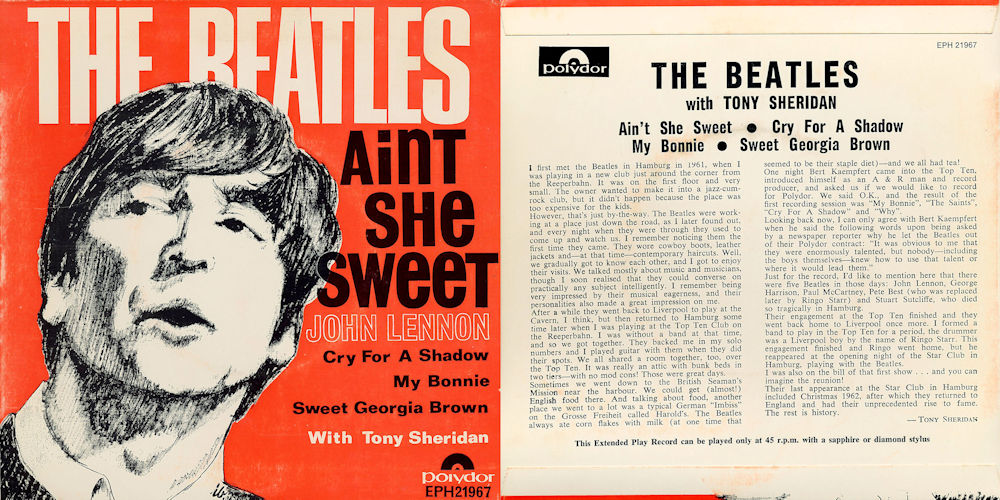
A release unique to Australia and New Zealand, featuring distinctive Australian-designed artwork by Philips artist Ian Brown.
Tracks Side 1: Ain't She Sweet / Cry For A Shadow Side 2: My Bonnie / Sweet Georgia Brown
Matrix Information Side 1: (mono) MX 144723 EPH 21967-1 46432A Side 2: (mono) MX 144724 46432B EPH 21967-2
Overview As Beatlemania swept across Australia in 1964, Polydor was quick to capitalise on its catalogue of Hamburg recordings featuring The Beatles and Tony Sheridan. Having already released ‘My Bonnie’/‘The Saints’ in February, ‘Cry for a Shadow’/‘Why’ in April and The Mersey Sound LP in May, the company followed with The Beatles with Tony Sheridan EP in June, coinciding with the Australian tours of both artists.
Tony Sheridan had commenced his Australian tour on 9 June, while The Beatles arrived on 11 June and began performing the following day. The timing provided an ideal opportunity for Polydor to promote its Hamburg recordings, although whether the EP was deliberately scheduled to coincide with these appearances remains unconfirmed.
Unlike the numerous overseas releases of this material, The Beatles with Tony Sheridan was unique to Australia and New Zealand. Its distinctive sleeve was designed locally by Philips artist Ian Brown, a talented illustrator and engraver whose work appeared on numerous Philips LP and EP covers. Brown would later become known to Australian record collectors for his striking artwork on Buffalo's albums during the 1970s.
Mastered and pressed by the Australian Record Company (ARC) for Philips Industries, the EP brought together four Hamburg recordings: ‘Ain't She Sweet’, ‘Cry for a Shadow’, ‘My Bonnie’ and ‘Sweet Georgia Brown’, the latter featuring the 1963 re-recorded vocal by Tony Sheridan.
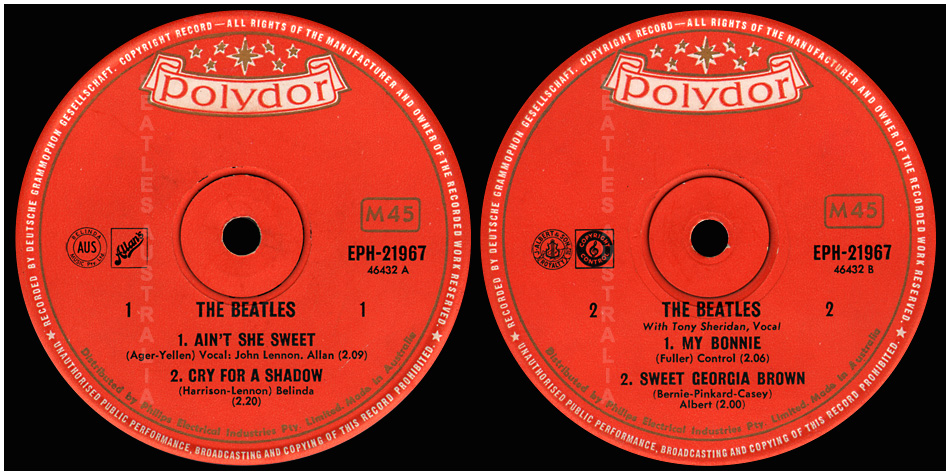
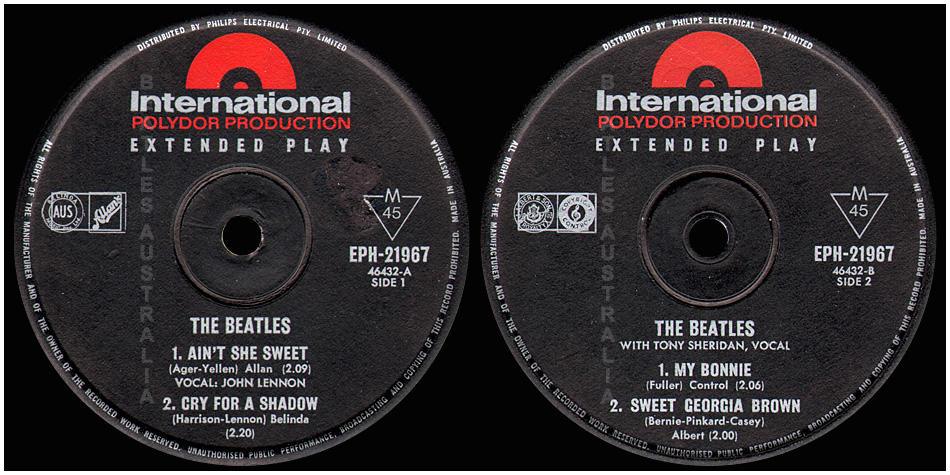
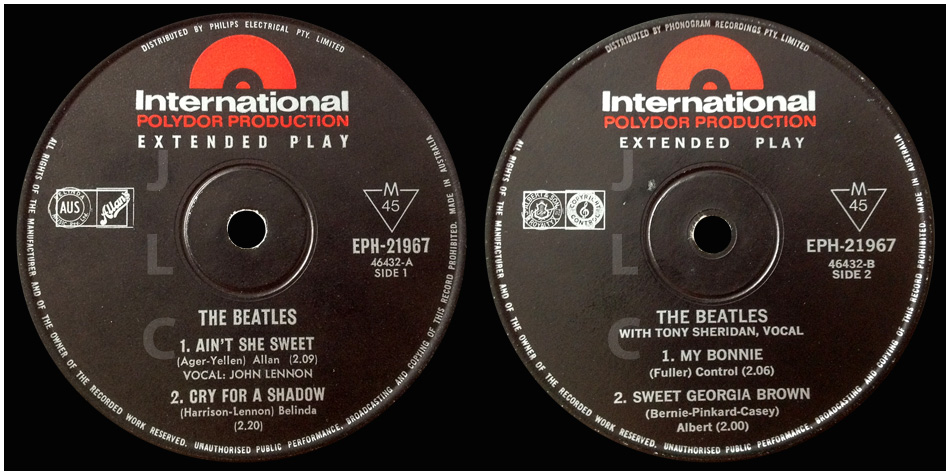
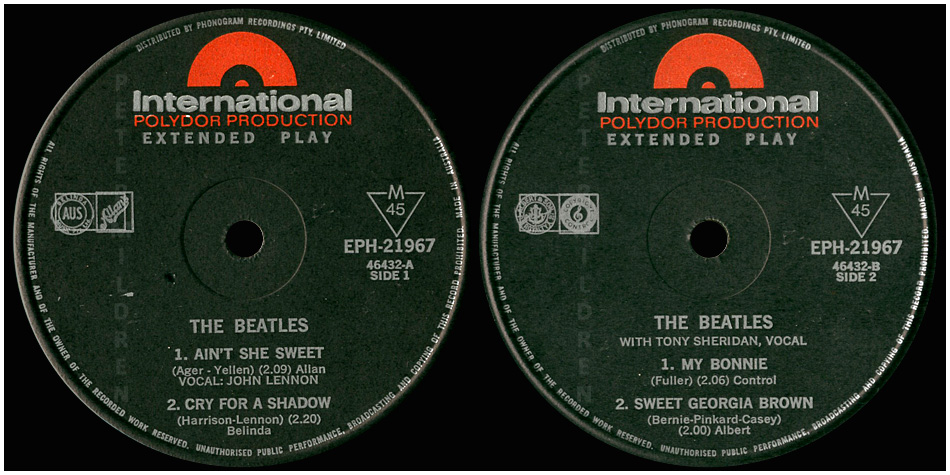
Although the EP did not make the singles charts, it proved to be a steady seller and remained available into the early 1970s. Its longevity resulted in several label and sleeve variations. Early copies featured a predominantly red sleeve, while examples produced from around mid-1966 displayed a noticeably more orange background. Changes to Polydor's Australian label design and company identification also provide useful clues for dating subsequent pressings, including a transitional variation featuring Philips Electrical on one side and Phonogram Recordings on the other, reflecting the company name change effective 1 July 1967.
The EP was also released in New Zealand from 1966, extending the life of this distinctively Australasian presentation of the Hamburg recordings. While the music itself would be repackaged countless times around the world, Ian Brown's memorable sleeve artwork remains one of the most recognisable and enduring features of this particular release.
Polydor Style 'A'
AUEP21967PA.a
Polydor Style 'B'
AUEP21967PB.a
Polydor Style 'C'
AUEP21967PC.a
Crossover variation, with Philips Electrical label on side 1 and Phonogram Recordings label on side 2.
Phonogram Recordings Pty Ltd was the new name for Philips' recorded music activities, coming into effect on 1 July 1967.