MATRIX INFORMATION
Machine Stamped - Hand Written
Machine Stamped - Hand Written
WITH THE BEATLES
Parlophone PMCO 1206 (MONO) / PCSO 3045 (STEREO)
Parlophone PMCO 1206 (MONO) / PCSO 3045 (STEREO)
| FORMAT | RELEASE DATE | SIDE 1 MATRIX | SIDE 2 MATRIX | PARTS |
| MONO | 22 Feb 1964 | XEX 447-1N | XEX 448-1N | UK |
| STEREO | 19 Mar 1964 | YEX 110-2 | YEX 111-2 | UK |
| STEREO | Aug 1979 | YEX 110-4 | YEX 111-2 | UK |
| STEREO | 11 Dec 1980 | TPCS 3045A-3 OR | TPCS 3045 B-4 DB | AU |
| MONO | 14 Nov 1988 | PCSO 3045D-A PB EMIDISC DMM |
PCSO 3045D-B-2 PB EMIDISC DMM |
AU |
SLEEVE INFORMATION
| ORIGIN | CODE | CIRCULATED | SLEEVE DETAILS |
| AUST | A1 | Feb 1964 | Mono catalogue number only; Australian designed flipback sleeve |
| AUST | A2 | Mar 1964 | Mono + stereo catalogue numbers; Australian designed flipback sleeve |
| AUST | A3 | Dec 1969 | Stereo catalogue number only; Australian designed non-flipback sleeve |
| AUST | A4 | 1981 | UK replica sleeve; stereo catalogue number only; local EMI details on rear cover |
| AUST | A5 | Nov 1988 | UK replica sleeve; "DIGITALLY REMASTERED" footer on rear cover |
The 1988 digital remaster, despite being mono like the 1987 CD release, maintained the stereo numbering system.
THE AUSTRALIAN VERSION OF THE SLEEVE
The Australian sleeve for With The Beatles was not merely a later point of collector interest. As first documented in Glenn A. Baker's The Beatles Down Under: The 1964 Australia & New Zealand Tour (Sydney: Wild & Woolley Press, 1981), the locally altered cover caused real friction at the time, most memorably during an EMI reception at Melbourne's Southern Cross Hotel.
Victorian EMI manager Cliff Baxter recalled John Lennon reacting angrily when he saw that EMI (Australia) had issued the album with a different sleeve design: "My most vivid memory of it, apart from having to forcibly move people around the room and away from the smothered Beatles, was John Lennon in an absolutely livid fit of anger because EMI here had designed a different cover for the With The Beatles album. I had to keep explaining that it was done at the Sydney headquarters and had nothing to do with me at all".
Kevin Ritchie, then EMI (Australia)'s National Promotion Manager, also found himself on the receiving end of Lennon's anger after presenting the group with copies of the Australian album when they met at Sydney's Sheraton Hotel: "I thought I was doing the right thing giving them copies of their new album, but it just started the tirade again. I was dismissed by John on the spot and he was going to contact the Chairman in London and have me fired and the whole of the Australian company was going to be sacked. I copped it because I was the only one accessible to them. Everyone at EMI was hiding behind closed doors, thinking 'oh dear here's the biggest thing ever to come out of the company and we've done the wrong thing by them'. As soon as it passed John had forgotten it and everything went along smoothly again".
Bill Robinson, then A&R manager, later explained that the change was driven by practical production limitations rather than any desire to depart from the UK design: "We would have gladly used the English cover if we had been able to. You see in those days there was no such thing as importing film negatives for covers, the unions wouldn't allow it. We had to reshoot everything from the overseas covers that we were sent. But the With The Beatles jacket was very shadowy and soft and our printers—all we had was letterpress printers then—made a complete botch of it, so we had to make up a new jacket with nice new clear, sharp photographs. We tried to explain all of this to the Beatles but I'm sure they didn't believe us".
Robinson's comments point to the wider local manufacturing environment in which Australian record sleeves were produced during the early 1960s. The issue was not simply artistic preference, nor even just technical inconvenience. It also reflected the industrial and political realities of the Australian printing trade, particularly the influence of the two major NSW-based printing unions then operating in the field: the Printing Industry Employees' Union of Australia, or PIEUA, and the Amalgamated Printing Trades Employees' Union, or APTEU.
Competitors until mid-1966, each had a strong interest in protecting the work of local members, including how photos should be taken and used to generate printed matter. In simplified terms, the expectation was that printed matter for the Australian market should be produced locally by union labour, rather than being generated directly from imported overseas materials such as photographic negatives. For record sleeves, this generally meant that front-cover artwork was recreated from locally made negatives (ie photos) taken from overseas sleeves, while back covers, being more heavily text-based, were usually retypeset from scratch in Australia.
This helps explain why a sleeve such as With The Beatles presented particular problems. The original UK cover relied on a soft, shadowy, high-contrast photographic image. Reproducing that image in Australia from a locally photographed copy of the UK sleeve would already have involved a loss of quality. That difficulty was then compounded by the printing methods commonly used by Australian sleeve printers at the time. In the early 1960s, local printers were still heavily wedded to letterpress printing, a process with obvious limitations when it came to subtle photographic reproduction. Full colour work, tonal blending and fine shadow detail were difficult to reproduce cleanly, and could also be expensive.
It is therefore not surprising that an Australian LP sleeve using the UK With The Beatles image would have appeared noticeably grainy or muddy, particularly in areas such as the collars and darker clothing. EMI (Australia) may have judged that reproducing the image to an acceptable standard at 12-inch LP size would either be technically unsatisfactory, commercially uneconomical, or both.
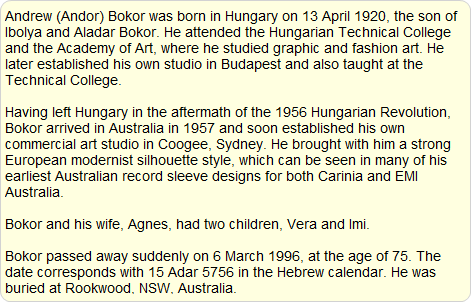
The solution was a new local sleeve, designed in quick time by commercial artist Andrew Bokor. Rather than attempting to imitate the dark, atmospheric Robert Freeman image, Bokor used a tried-and-tested commercial approach: the "floating heads" design. It was a simple, clear and highly legible layout, built around separate, sharp photographic portraits of the four Beatles—taken by Dezo Hoffman on 20 June 1963—rather than a single shadow-heavy group image. From a printing perspective, this made practical sense. The design avoided the most difficult aspects of the UK cover while still placing the group's faces prominently on the front sleeve, which was the main selling point for a fast-moving pop album.
In that context, the Australian sleeve becomes easier to understand. It was not merely a careless substitution, nor simply a provincial redesign. It was a quick local solution to a very specific set of industrial, technical and economic constraints. That did not make it acceptable to The Beatles, who clearly saw it as an unauthorised alteration of their album presentation, but it does explain why EMI (Australia) arrived at such a different result.
There is, however, an interesting postscript. EMI (Australia) still used the original image twice on EP sleeves: first as a straight monotone reduction for The Beatles No. 1, and later, with reduced shadow and increased grain, for All My Loving. Visually, these EP sleeves appear to draw on the same source image, but from a printing perspective they were not the same proposition as a full-sized LP cover. The smaller format, non-laminated presentation and altered tonal treatment meant that the image could be reproduced to a merely acceptable standard, rather than needing to carry the visual impact of a 12-inch album sleeve.
Look closely at All My Loving and the EP image is not smoothly blended; it has a harder, grainier quality. But at EP size, that compromise was good enough. The disputed Australian LP sleeve therefore stands apart not because the UK image was entirely unusable in Australia, but because the technical, industrial and economic limitations of the time made it difficult to reproduce satisfactorily in the larger album format.
By the late 1960s, this situation had begun to change. Newer printing methods, including offset lithography and the installation of a Klischograph at EMI primary sleeve printer F. H. Booth & Son, gradually improved the reproduction of photographic artwork, while the amalgamation of the competing printing unions helped reshape the industrial landscape. The Australian With The Beatles sleeve belongs very much to the earlier period, when local union rules, local printing practices and local technical limitations could combine to produce a cover quite different from its British counterpart.
Around early 1981, EMI (Australia) finally brought the Australian edition into line with its British counterpart, replacing the distinctive local sleeve with a replica of the original UK design.
LABEL NOTES
The premiere Australian release of With The Beatles retained the gold label design as seen on the earliest pressings of Please Please Me, even though by then UK pressings had adopted the new 'yellow Parlophone' design.
A disagreement over music-publishing rights ensued in relation to track 2.7, 'Money'. Prior to November 1963, Tu-Con Music controlled Jobete Music titles in Australia. However, following lengthy discussions between Tu-Con and Belinda Music during November, the majority of the Jobete catalogue, including 'Money', moved under the control of Belinda. As the paperwork for With The Beatles was completed before the ownership was resolved and notified, early With The Beatles labels credited Tu-Con as the publisher; a timing error that was corrected mere weeks later (see gold label - variation 'b'). The 'Money'/Tu-Con label was issued, virtually exclusively, in 'mono-catalogue number only' sleeves.
Interestingly, however, at least two variations of the post-March 1964 "Banner" stereo label credited 'Money' to Tu-Con. This is perhaps a printer oversight in reading the Acceptance Sheet, because by this time the track was controlled by J Albert & Son. It's quite possible than an equivalent, as yet unidentified, mono label variation exists with the same error.
The infamous 'You Really Gotta Hold On Me' error that appeared on label and sleeve (see above) tracklists on early UK pressings of With The Beatles, was duplicated on early local pressings. 'Gotta' was corrected to 'Got A' for the third variation of the gold label but reverted to 'Gotta' with the appearance of the mono yellow Parlophone label (and coincident with a change in publishing credit from Belinda to Albert), which is how it remained until changed back to 'Got A' with the issue of 'Side-Stereo' orange labels.
THE AUSTRALIAN VERSION OF THE SLEEVE
The Australian sleeve for With The Beatles was not merely a later point of collector interest. As first documented in Glenn A. Baker's The Beatles Down Under: The 1964 Australia & New Zealand Tour (Sydney: Wild & Woolley Press, 1981), the locally altered cover caused real friction at the time, most memorably during an EMI reception at Melbourne's Southern Cross Hotel.
Victorian EMI manager Cliff Baxter recalled John Lennon reacting angrily when he saw that EMI (Australia) had issued the album with a different sleeve design: "My most vivid memory of it, apart from having to forcibly move people around the room and away from the smothered Beatles, was John Lennon in an absolutely livid fit of anger because EMI here had designed a different cover for the With The Beatles album. I had to keep explaining that it was done at the Sydney headquarters and had nothing to do with me at all".
Kevin Ritchie, then EMI (Australia)'s National Promotion Manager, also found himself on the receiving end of Lennon's anger after presenting the group with copies of the Australian album when they met at Sydney's Sheraton Hotel: "I thought I was doing the right thing giving them copies of their new album, but it just started the tirade again. I was dismissed by John on the spot and he was going to contact the Chairman in London and have me fired and the whole of the Australian company was going to be sacked. I copped it because I was the only one accessible to them. Everyone at EMI was hiding behind closed doors, thinking 'oh dear here's the biggest thing ever to come out of the company and we've done the wrong thing by them'. As soon as it passed John had forgotten it and everything went along smoothly again".
Bill Robinson, then A&R manager, later explained that the change was driven by practical production limitations rather than any desire to depart from the UK design: "We would have gladly used the English cover if we had been able to. You see in those days there was no such thing as importing film negatives for covers, the unions wouldn't allow it. We had to reshoot everything from the overseas covers that we were sent. But the With The Beatles jacket was very shadowy and soft and our printers—all we had was letterpress printers then—made a complete botch of it, so we had to make up a new jacket with nice new clear, sharp photographs. We tried to explain all of this to the Beatles but I'm sure they didn't believe us".
Robinson's comments point to the wider local manufacturing environment in which Australian record sleeves were produced during the early 1960s. The issue was not simply artistic preference, nor even just technical inconvenience. It also reflected the industrial and political realities of the Australian printing trade, particularly the influence of the two major NSW-based printing unions then operating in the field: the Printing Industry Employees' Union of Australia, or PIEUA, and the Amalgamated Printing Trades Employees' Union, or APTEU.
Competitors until mid-1966, each had a strong interest in protecting the work of local members, including how photos should be taken and used to generate printed matter. In simplified terms, the expectation was that printed matter for the Australian market should be produced locally by union labour, rather than being generated directly from imported overseas materials such as photographic negatives. For record sleeves, this generally meant that front-cover artwork was recreated from locally made negatives (ie photos) taken from overseas sleeves, while back covers, being more heavily text-based, were usually retypeset from scratch in Australia.
This helps explain why a sleeve such as With The Beatles presented particular problems. The original UK cover relied on a soft, shadowy, high-contrast photographic image. Reproducing that image in Australia from a locally photographed copy of the UK sleeve would already have involved a loss of quality. That difficulty was then compounded by the printing methods commonly used by Australian sleeve printers at the time. In the early 1960s, local printers were still heavily wedded to letterpress printing, a process with obvious limitations when it came to subtle photographic reproduction. Full colour work, tonal blending and fine shadow detail were difficult to reproduce cleanly, and could also be expensive.
It is therefore not surprising that an Australian LP sleeve using the UK With The Beatles image would have appeared noticeably grainy or muddy, particularly in areas such as the collars and darker clothing. EMI (Australia) may have judged that reproducing the image to an acceptable standard at 12-inch LP size would either be technically unsatisfactory, commercially uneconomical, or both.
The solution was a new local sleeve, designed in quick time by commercial artist Andrew Bokor. Rather than attempting to imitate the dark, atmospheric Robert Freeman image, Bokor used a tried-and-tested commercial approach: the "floating heads" design. It was a simple, clear and highly legible layout, built around separate, sharp photographic portraits of the four Beatles—taken by Dezo Hoffman on 20 June 1963—rather than a single shadow-heavy group image. From a printing perspective, this made practical sense. The design avoided the most difficult aspects of the UK cover while still placing the group's faces prominently on the front sleeve, which was the main selling point for a fast-moving pop album.
In that context, the Australian sleeve becomes easier to understand. It was not merely a careless substitution, nor simply a provincial redesign. It was a quick local solution to a very specific set of industrial, technical and economic constraints. That did not make it acceptable to The Beatles, who clearly saw it as an unauthorised alteration of their album presentation, but it does explain why EMI (Australia) arrived at such a different result.
There is, however, an interesting postscript. EMI (Australia) still used the original image twice on EP sleeves: first as a straight monotone reduction for The Beatles No. 1, and later, with reduced shadow and increased grain, for All My Loving. Visually, these EP sleeves appear to draw on the same source image, but from a printing perspective they were not the same proposition as a full-sized LP cover. The smaller format, non-laminated presentation and altered tonal treatment meant that the image could be reproduced to a merely acceptable standard, rather than needing to carry the visual impact of a 12-inch album sleeve.
Look closely at All My Loving and the EP image is not smoothly blended; it has a harder, grainier quality. But at EP size, that compromise was good enough. The disputed Australian LP sleeve therefore stands apart not because the UK image was entirely unusable in Australia, but because the technical, industrial and economic limitations of the time made it difficult to reproduce satisfactorily in the larger album format.
By the late 1960s, this situation had begun to change. Newer printing methods, including offset lithography and the installation of a Klischograph at EMI primary sleeve printer F. H. Booth & Son, gradually improved the reproduction of photographic artwork, while the amalgamation of the competing printing unions helped reshape the industrial landscape. The Australian With The Beatles sleeve belongs very much to the earlier period, when local union rules, local printing practices and local technical limitations could combine to produce a cover quite different from its British counterpart.
Around early 1981, EMI (Australia) finally brought the Australian edition into line with its British counterpart, replacing the distinctive local sleeve with a replica of the original UK design.
LABEL NOTES
The premiere Australian release of With The Beatles retained the gold label design as seen on the earliest pressings of Please Please Me, even though by then UK pressings had adopted the new 'yellow Parlophone' design.
A disagreement over music-publishing rights ensued in relation to track 2.7, 'Money'. Prior to November 1963, Tu-Con Music controlled Jobete Music titles in Australia. However, following lengthy discussions between Tu-Con and Belinda Music during November, the majority of the Jobete catalogue, including 'Money', moved under the control of Belinda. As the paperwork for With The Beatles was completed before the ownership was resolved and notified, early With The Beatles labels credited Tu-Con as the publisher; a timing error that was corrected mere weeks later (see gold label - variation 'b'). The 'Money'/Tu-Con label was issued, virtually exclusively, in 'mono-catalogue number only' sleeves.
Interestingly, however, at least two variations of the post-March 1964 "Banner" stereo label credited 'Money' to Tu-Con. This is perhaps a printer oversight in reading the Acceptance Sheet, because by this time the track was controlled by J Albert & Son. It's quite possible than an equivalent, as yet unidentified, mono label variation exists with the same error.
The infamous 'You Really Gotta Hold On Me' error that appeared on label and sleeve (see above) tracklists on early UK pressings of With The Beatles, was duplicated on early local pressings. 'Gotta' was corrected to 'Got A' for the third variation of the gold label but reverted to 'Gotta' with the appearance of the mono yellow Parlophone label (and coincident with a change in publishing credit from Belinda to Albert), which is how it remained until changed back to 'Got A' with the issue of 'Side-Stereo' orange labels.
GENERAL ALBUM INFORMATION
PAGE LAST UPDATED: 17 AUGUST 2026


GOLD MONO B
AU1206M1
22 Feb 1964
AU1206M1
22 Feb 1964
YELLOW/BLACK mono
AU1206M2
Mar 1964
AU1206M2
Mar 1964

NZ YELLOW mono
AU1202M3
1968
AU1202M3
1968
'BANNER' STEREO
AU3045S1
19 Mar 1964
AU3045S1
19 Mar 1964
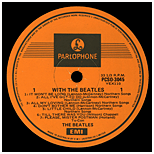
ORANGE 1-BOX C
AU3045S3C
1979
AU3045S3C
1979


ORANGE 1-BOX A
AU3045S3A
Q3 1969
AU3045S3A
Q3 1969
ORANGE 1-BOX B
AU3045S3B
Oct 1978
AU3045S3B
Oct 1978

BLACK 1-BOX A
AU3045S5A
Apr 1982
AU3045S5A
Apr 1982

NZ DK GREY 1-BOX
AU3045S4B
1981
AU3045S4B
1981
BLACK 1-BOX B
AU3045S5B
Jul 1987
AU3045S5B
Jul 1987

NZ YELLOW stereo
AU3045S2
1968
AU3045S2
1968